
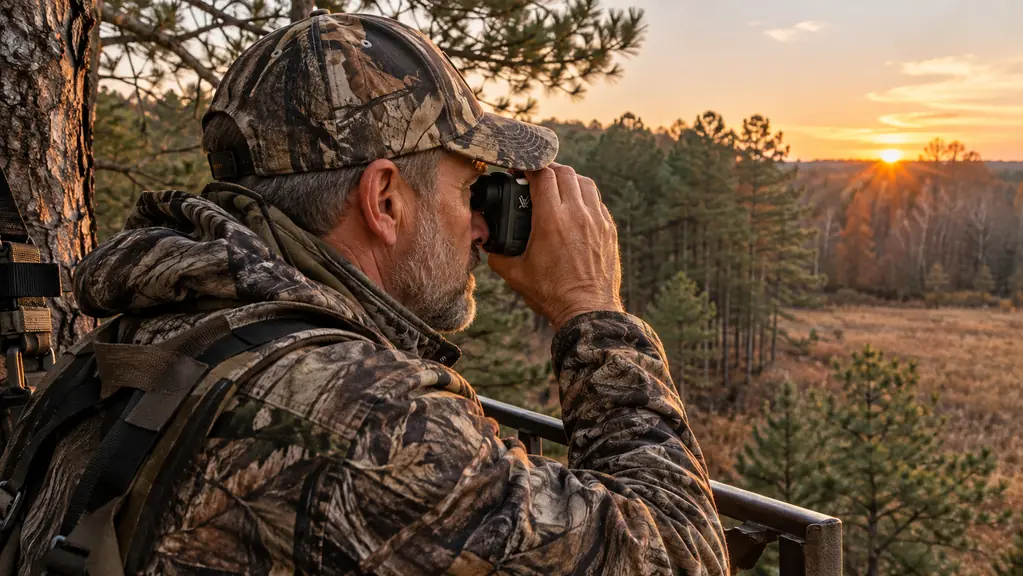
I have guessed yardage by eye for most of 46 seasons, and I have guessed wrong more times than I care to count. Near the end of the 2024 season, coming off the top of my ladder stand, I slipped on a wet step and spent a couple of seconds hanging by one arm before I got my feet back under me. That shook me enough that my son Cody talked me into upgrading the whole kit at once. One of the pieces I added was the Bushnell BoneCollector 850, and I have carried it through the 2025-26 deer season and the spring turkey season since. Here is what a full season of real hunting taught me about it.
The Quick Verdict
The Bushnell BoneCollector 850 is the rangefinder that stays in my truck now. It ranges fast, reads true out to the distances I actually shoot, and the scan mode earns its keep on a moving buck. It is not the brightest glass in low light, and the CR2 battery is a pain to find in a small town, but it did its job every single hunt.
Amazon Check Today's Price →Stop guessing the yardage and start ranging it
A missed guess costs you the shot. The Bushnell BoneCollector 850 gives you a fast, reliable number out to 850 yards, and it fits in your coat pocket. This is the rangefinder I reached for all season.
Amazon Check Today's Price on Amazon →How I've Used It
I bought the BoneCollector 850 in late summer 2025, before deer season opened, and it has ridden in my coat pocket for every hunt since. Our family lease is mixed pine and hardwood bottoms about an hour north of Mobile, and I hunt it from a ladder stand on the east side of a field edge and from a ground blind that I set up in February for turkeys. The food plot sits maybe two hundred yards across the middle, which is a good distance to learn what a rangefinder can do. I have also carried it on a few public-land sits, where the cover is thicker and the distances are shorter. Cody has his own gear, so the Bushnell has been mine alone. It has been rained on, bumped against a treestand rail, and dropped once onto pine straw, and it has never once stopped working.
The specs say it ranges 350 to 850 yards, with 500 yards to a tree and 350 yards to a deer. Those numbers match what I saw in the field. On opening morning in November I ranged the far treeline before first light, just to build the habit. On a doe standing in the field edge it gave me a number a little farther than my guess. On a big pine across the creek, it locked on just as quickly. I did not spend much time ranging long distances this season, but I tested it on a hay barn across the valley from a friend's place and it locked on the first try. By December I was ranging everything without thinking: the corner post of the food plot, a lone pine, the stump where a buck had rubbed the bark off. That habit is the real reason I bought it. A rangefinder only helps if you use it on every sit, and this one is small enough that using it is the easy part. It also updates range four times per second in scan mode, which I used more than I expected. When a buck is working a field edge and will not stand still, that fast refresh keeps the number true.
What the BoneCollector 850 Gets Right
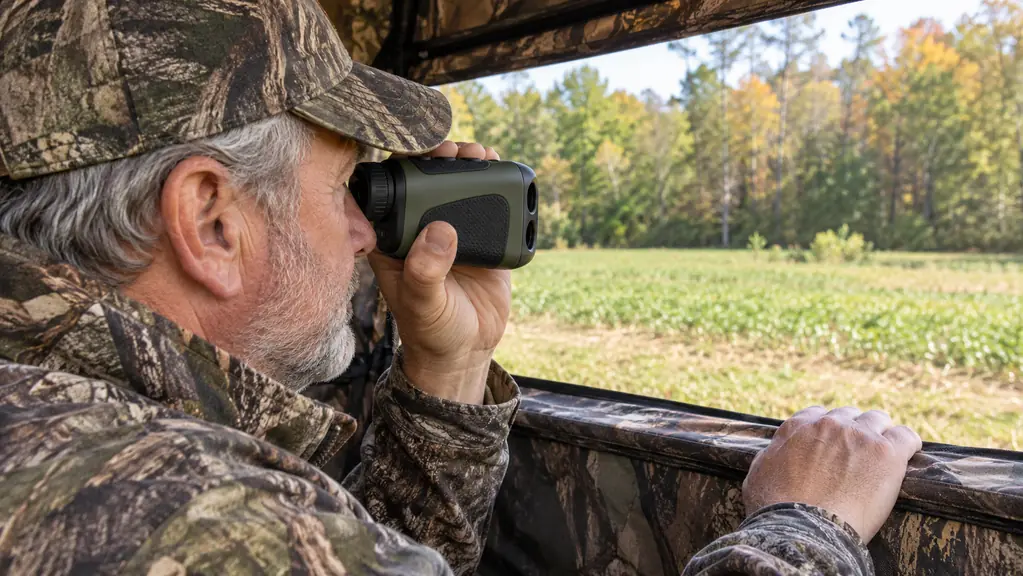
The first thing I noticed was the speed. I have used rangefinders that made you hold steady for what felt like three or four seconds before they gave you a number. The Bushnell gives it up fast, and the scan mode keeps feeding you new numbers as the deer moves. I proved it to myself one afternoon in mid-October. I picked a stump and guessed the distance, then ranged it. Then a fence post. I was short both times, and I was off by more than I wanted to admit, and that was on objects sitting perfectly still. A deer moving through the same field would have been worse. The Bushnell gave me the real numbers in under a second each time, and the scan mode kept updating as I moved across the field. That afternoon is when I stopped trusting my eye and started trusting the tool. A buck that is walking a field edge gives you a two-second window, and this unit fits inside that window.
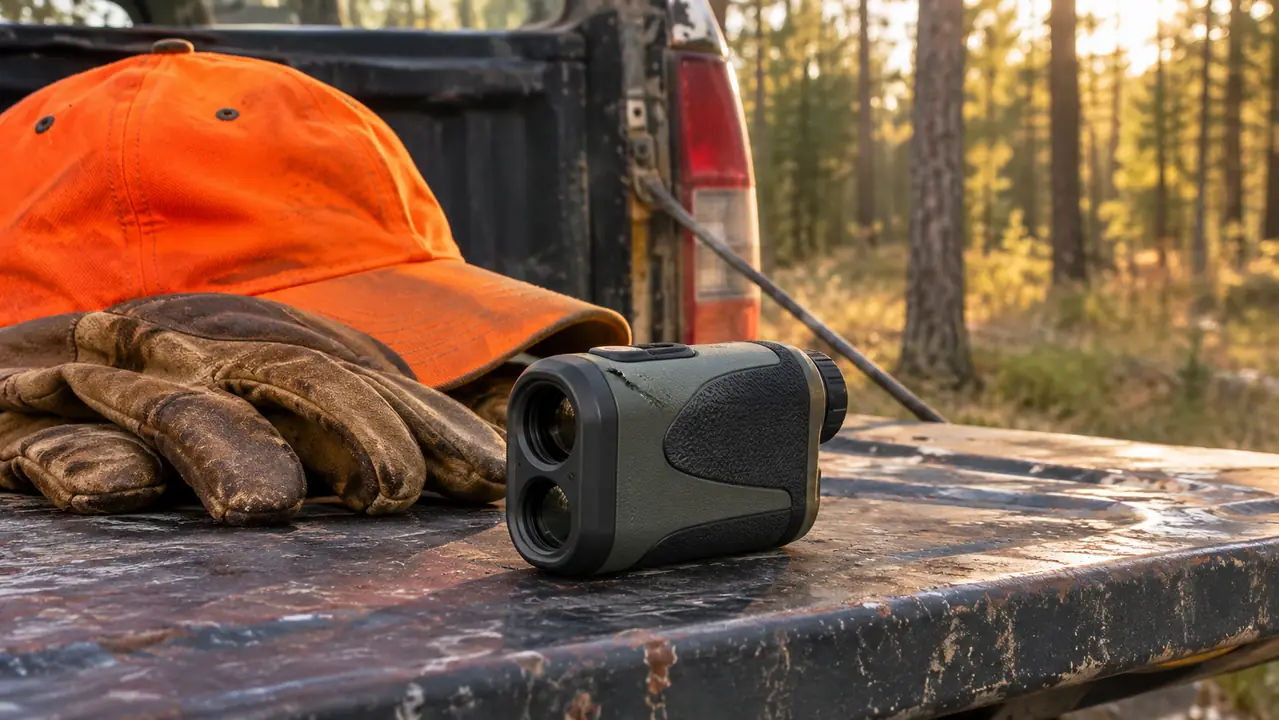
The second thing is the all-glass optical system. Bushnell put fully multi-coated optics with ultra wide band coatings on this thing, and the image is genuinely bright and true to color. I compared it side by side with an older rangefinder a buddy owns, and the difference in clarity was obvious. The 6x24mm magnification is plenty for ranging deer, and the Realtree Edge finish blends in when I set it down in the stand. The morning that sold me on the waterproofing was the third Saturday of December. Fog sat on the field until almost nine o'clock, then the drizzle started and never really stopped. I ranged a doe through the mist and the number did not flicker. I wiped the lens on my sleeve once and the image stayed clear. The case that came with it has ridden in my pack ever since, but the unit itself has spent the season hanging from a lanyard in the open air, and the rain has not touched the inside of the glass. It is waterproof with an IP54 rating, and that morning proved the rating was not just a line on a box.
The third thing is the weight. At 180 grams, it disappears in a coat pocket. I have carried rangefinders that felt like a brick on a lanyard around my neck. This one I forget I have until I need it, and that means I actually use it on every shot instead of only on the long ones. The dimensions help too. At 3.19 inches long and 2.36 inches wide, it tucks into the small pocket of my hunting coat without bulging, and it does not catch on brush when I am walking in before daylight. I have had bulkier units snag on briars and pull the lanyard tight against my neck. This one stays put.
Where It Falls Short
I would be lying if I said the BoneCollector 850 was perfect. In the last few minutes of shooting light, the image gets dimmer than I would like. The moment I remember best was a January evening when a doe stepped out at the far end of the field with maybe four minutes of legal light left. I could see her well enough through my binoculars to know she was a doe, but when I put the Bushnell up, the image was noticeably darker. I still got the number, but I had to hold steady and work for it. If she had been a buck and I had needed to confirm antlers through that same glass, I would have wanted more light transmission. It is still usable, but it is not the brightest glass I have looked through. If you do most of your shooting in dark timber at first light, you may find yourself wishing for more. I hunted mostly field edges and food plots, so it rarely cost me anything, but it is a real limitation.
The battery is my other gripe. It takes a disposable 3V lithium CR2, and CR2s are not something you find at every gas station. The CR2 bit me once, in early February. The battery gave out between sits, and I had not thought to carry a spare. I drove to three stores before I found one. The gas station clerk had never heard of a CR2. The hardware store had them behind the counter, two of them, dusty. I bought both, and now a spare lives in the glove box of the truck, checked on the same day I check my license. It is a small thing, but it is exactly the kind of small thing that ends a hunt morning before it starts. The unit is also plastic, which keeps the weight down but means you want to treat it with reasonable care. It survived a season in my pocket, but I would not throw it loose in a bag with a set of wrenches.
The scan mode updates four times per second. On a buck working a field edge, that fast refresh is the difference between a number you can trust and a number you are guessing at.
How It Performed Over a Full Season
I took a good buck and a doe last season, and the Bushnell was part of both sits. The buck came in on the second Saturday of December, a cold morning with a north wind. He entered the field at the far end, worked the edge for a while, then started across. I ranged him three times as he moved, and the number updated each time he quartered and stopped to look back at the treeline. Knowing the real distance meant I did not have to guess at holdover. There was maybe fifteen minutes of light left, and the rangefinder turned a rushed situation into a calm one. I do not know if I would have taken that shot in the old days when I was guessing. I would like to say yes, but I have missed enough guessed yardages to know better.
The spring turkey season was where the scan mode really earned its keep. A gobbler does not stand still for you. He struts, he turns, he steps sideways, and he disappears behind a bush for three seconds. The morning I remember best was late March, a gobbler hanging up at the field edge about two hundred yards out. He strutted back and forth for the better part of an hour, and I kept the button down the whole time. The number moved with him as he turned and stepped behind a cedar. When he finally broke and walked toward the decoy, I already knew the distance. I did not take him that morning, a limb got in the way at the worst possible second, but the rangefinder had done its job and then some. That is the whole job of a rangefinder, and this one does it without fuss.
I also used it for non-hunting stuff more than I expected. Ranging a tree line to plan a setup. Checking the distance across a creek to see if a crossing was worth the wade. Even ranging a hawk on a fence post one afternoon just to see if it would lock on. It locked on fast, and it held the number while the hawk sat there. A rangefinder that cannot lock a bird sitting still is not going to lock a deer's chest, so that little test told me the optics and the ranging engine were working together the way they should.
What I Liked
- Fast ranging with a scan mode that updates four times per second
- Compact and light at 180 grams, easy to carry on every sit
- Bright all-glass, fully multi-coated optics with true-to-life color
- Waterproof with an IP54 rating, proven on a wet December morning
- Simple to use, the kind of tool you forget you are carrying
Where It Falls Short
- Image gets dim in the last few minutes of shooting light
- Runs on a disposable CR2 battery that can be hard to find locally
- Plastic body needs reasonable care, not built to be thrown around
- Measuring range tops out at 850 yards, so it is not for extreme long-range work
Who This Is For
The BoneCollector 850 is for the hunter who wants a dependable, no-fuss rangefinder that covers the distances most deer and turkey hunters actually shoot. If you hunt field edges, food plots, power lines, or any open ground where you have to judge 200 to 400 yards, this unit gives you a fast, repeatable number. It is also a great choice for a newer hunter who wants to learn what distances really look like instead of guessing. The scan mode makes it easy to range moving game, and the compact size means you will actually carry it. For my money, that last part is the one that matters most. The best rangefinder in the world is useless if it stays in the truck, and this one has not spent a hunt in the truck since I bought it.
Who Should Skip It
If you do most of your hunting in the last five minutes of legal light in heavy timber, you may want a rangefinder with brighter glass. If you need to range past 850 yards on a regular basis, this is not the unit for you; the measuring range tops out there. And if you hate tracking down CR2 batteries, the disposable 3V lithium requirement will annoy you. None of those are dealbreakers for me, but they are honest reasons a different hunter might pick something else. I would also say this: if you already own a rangefinder that you trust and that fits your hunting, there is no reason to swap just for the sake of swapping. Upgrade when a tool earns it, not because a new one is shiny.
A full season says it earns its spot in the truck
The Bushnell BoneCollector 850 ranged every deer and turkey I put in front of it this season, and it never let me down when the light mattered. If you are done guessing yardage, this is the rangefinder to start with.
Amazon Check Today's Price on Amazon →