
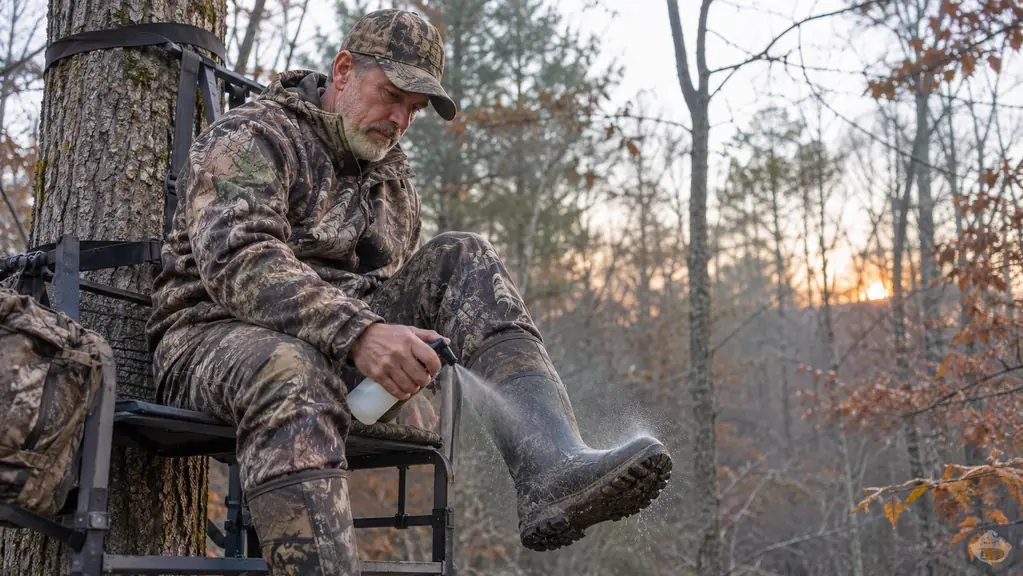
I played the wind for more than forty years. I set up where the breeze felt right, I washed my clothes in baking soda, and I still got busted on more mornings than I care to count. A deer would come in nose down, lock up at forty yards, and blow out like I had rung a dinner bell. My son Cody finally talked me into doing this right before last season, and the Wildlife Research Center Scent Killer Gold Spray is the piece of the kit I reach for first now. I am not a scientist and I do not pretend to be one. I am a retired lineman who has hunted these same pine and hardwood bottoms for most of his life, and I trust what works.
This is not a magic trick. A spray will not save you if you walk straight into the wind. What it does is give you one less thing to worry about, and in this sport, one less thing is usually the difference between a buck in range and a buck that is gone. Here is how I use it, step by step, the way I would walk a new hunter through it at camp.
Stop letting your scent write the ending before the hunt starts
The Wildlife Research Center Scent Killer Gold Spray and Refill combo is the bottle I keep in the truck for every deer hunt. Check today's price on Amazon.
Amazon Check Today's Price on Amazon →Step 1: Start with a clean foundation
The spray works best when it is not fighting a week of campfire smoke and last season's cover scent. I wash my hunting clothes in scent-free detergent and store them in a plastic tote with a lid. Boots get the same treatment: I wipe them down and keep them out of the garage where the fuel smell lives. The tote lives in the bedroom closet, not the garage, because the garage is where the truck, the gas cans, and every other smell I am trying to avoid call home.
You do not need a laundry room full of gear to make this work. You need a clean base layer, clean outer layers, and boots that do not smell like the inside of a truck. The Wildlife Scent Killer Gold is designed for hunting outerwear and boot bottoms, and it does its best work when you give it a fair start. I have hunted public land and private land in south Alabama for 46 years, and the one thing every good hunter I know has in common is a routine. The routine does not have to be fancy. It just has to happen every time.
I learned this the hard way. The first time I used a scent spray, I sprayed it over a jacket that had been hanging in the garage all summer. I might as well have saved the spray. Start clean, or do not bother.
Step 2: Spray your boots first, bottoms and all
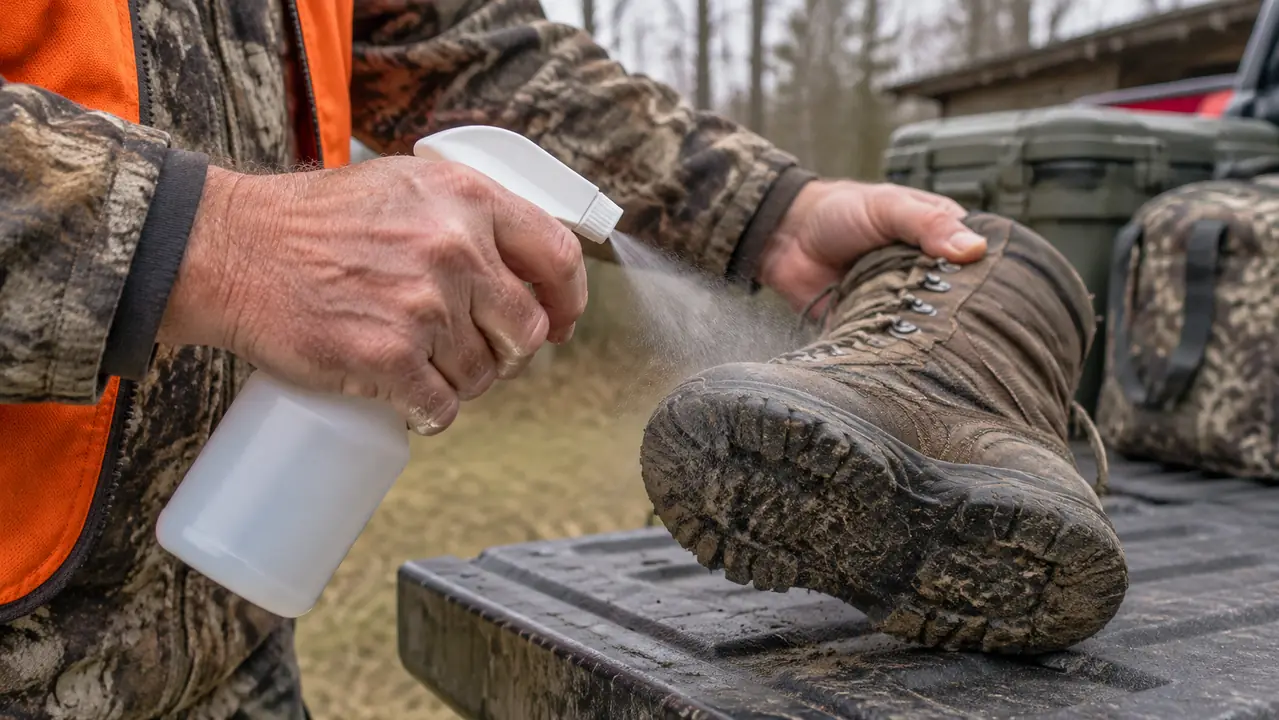
Boots are the first thing that touches the ground, and the ground is where the deer live. I spray the bottoms of my boots, the sides, and the laces before I put them on. That sounds like a small thing, but the bottom of a boot picks up everything from the truck floor to the food plot edge. I remember the first Saturday of December last season. It was 28 degrees with a hard frost, and I parked at the edge of the food plot on the lease about an hour north of home. I sat on the tailgate of my old pickup, sprayed the bottoms of my boots, and let them dry while I finished my coffee. That was the morning a doe came in at twenty yards, nose working, and never once locked up on me. She walked the same path I had walked in. I am not saying the spray did all of it, the wind was right, but it was the first time in years I had walked into a setup and not felt like I was leaving a trail behind me.
The Wildlife Research Center Scent Killer Gold comes as a 44 ounce combo pack with a spray bottle and a refill bottle. That is a full season of boot bottoms and outer layers for me, and I am not shy with it. I give each boot a good mist, let it dry while I finish getting ready, and give the uppers another pass before I leave the truck. The label cites testing at Rutgers University that found it 99 percent effective at stopping replicated human odor. That number means something to me because it is a test, not a claim. I have been around enough marketing to know the difference.
Some folks spray a circle on the ground and stand in it. I have tried that. It does not hurt, but I trust a direct spray on the boot more. The point is to keep human odor off the path you walk, and the path starts at your feet.
Step 3: Mist your outer layers, not your skin
I spray my jacket, my vest, my hat, and the outside of my pants. I do not spray my base layer or my skin. The product is a liquid, it is unscented, and it is made for hunting outerwear, so I keep it on the outside where the air moves.
The way I do it is simple: hang the jacket on the truck mirror or lay it across the tailgate, give it a light mist from about a foot away, and let it dry before I put it on. I do the same for my hat and my vest. It takes three minutes and it beats the old habit I had of spraying myself in the dark and hoping for the best. Opening weekend of last season, I was in the ladder stand on the ridge above the hardwoods. The wind had been out of the northwest all morning, steady, the way you like it. Then around nine o'clock it died and swung around to the southeast for about ten minutes before settling back. A buck came up the draw below me, and I watched him stop and turn his head into that swirl. He stood there for a long moment, then went back to feeding. I had sprayed my jacket and vest before I climbed, and I am convinced that ten minute window is the reason he did not blow out. Before I started using the spray, that exact situation had ended my hunt more than once.
One note from the label that I follow: this is designed for hunting outerwear and boot bottoms to help keep you undetected in the wild. It is not a substitute for playing the wind. I still set up downwind of where I expect deer to move. The spray just makes the times when the wind swirls a little less costly.
Step 4: Reapply at the stand, then keep your hands off your face
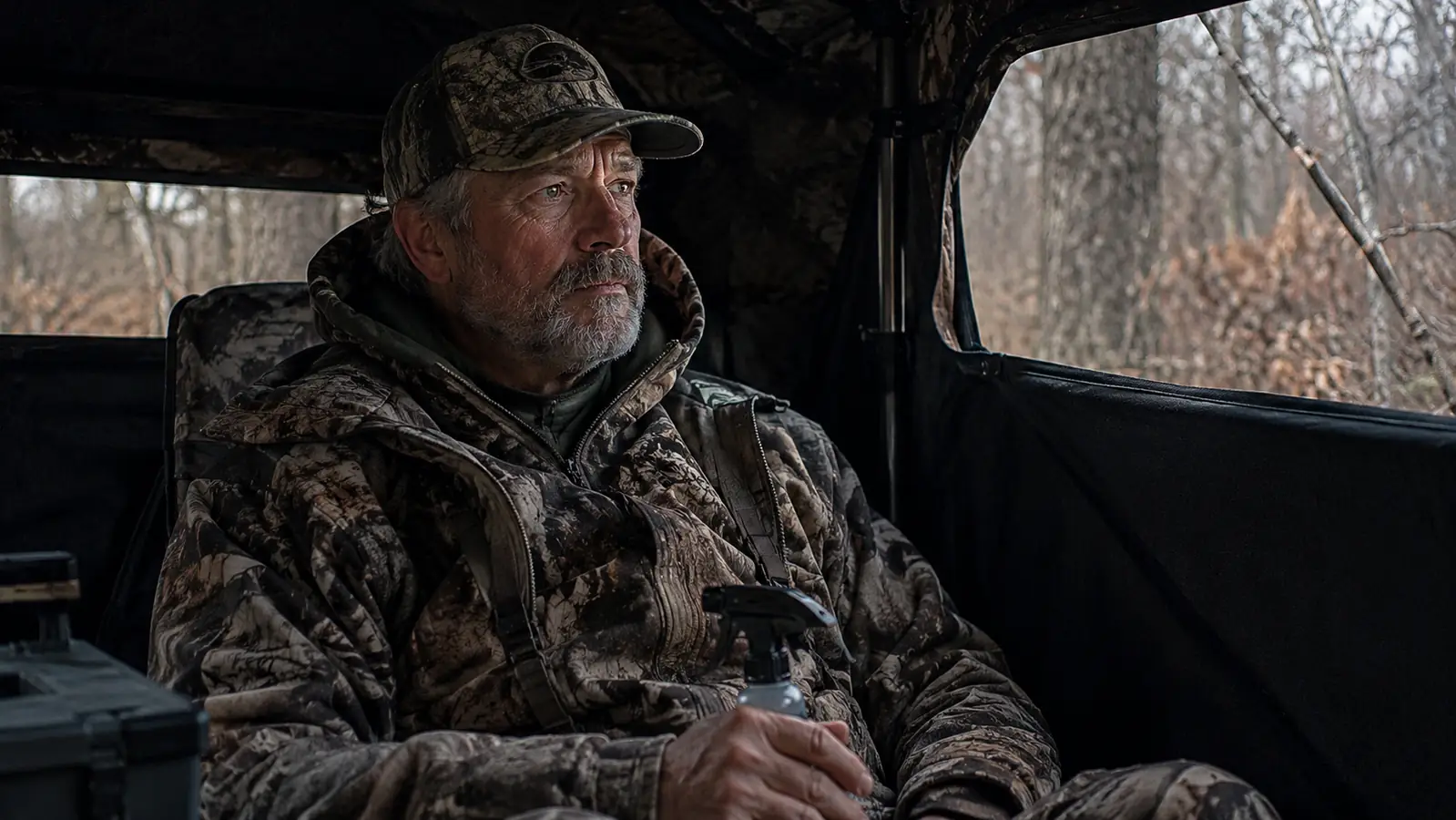
I keep the spray bottle in my pack and take one more pass when I get to the base of the ladder stand. That is the moment when I am the most worked up, the most likely to be sweating, and the closest to where the deer will walk. A quick mist on the cuffs and the collar is worth the thirty seconds.
Then I leave it alone. The mistake most hunters make, including me for years, is touching everything after they spray. You blow your nose, you adjust your hat, you eat a granola bar, and you have painted your scent right back over the spray. I learned that lesson on a cold morning in January on public land. I had done everything right: clean clothes, sprayed boots, sprayed outer layers, walked in slow. I got to the ground blind, settled in, and ate a granola bar while I waited. About an hour later a buck came down the edge of the thicket, and when he hit the spot where I had been standing outside the blind, he stopped, stamped, and circled wide. It took me a while to figure out what I had done. The wrapper was in my pack, but my fingers had touched the bar, then my face, then the zipper pull on my jacket. I had put human scent right back on the one spot I needed to stay clean. Now I keep a small towel in my pack, I do not eat in the stand, and I do not touch my outer layers once I am set up.
This is the step nobody tells you about. The spray is not a force field. It is a head start, and you can throw that head start away with one careless habit.
Step 5: Store it in the truck, not the garage
I keep the bottle of Wildlife Scent Killer Gold plus the refill in the truck, in a small plastic bin with my gloves and my rangefinder. That way it is always there, it is not sitting in a hot garage all summer, and I never forget it on the kitchen counter. The combo pack is convenient for exactly that reason: one bottle to carry, one to refill. It earns its keep in the spring too. I used the same bottle for turkey season in March and April, spraying my boots and the knees of my pants before I set up on a roosted bird. A turkey's eyes are the first thing everyone talks about, but their ears and nose are nothing to ignore. The bottle still had plenty left when turkey season ended, which tells me the 44 ounce combo is about the right size for a full year of hunting. I keep the spray bottle in my pack and the refill in the truck, and I have not bought a new combo since the summer of 2025.
At the end of the season I check the bottles, and if one is getting low, I pick up a fresh combo before the next opener. I do not wait until the week of the hunt. Scent control is a habit, and habits are built in the off season. I learned that the hard way a few years back when I showed up for opening morning with a bottle that had gone dry. I hunted anyway and spent the whole sit second-guessing every step I had taken in.
One more thing: the product is unscented, and I like that. I have used cover scents that smell like pine and acorn, and they have their place. But for a straight scent-control spray, unscented means I am not adding a new smell to the woods. I am just taking mine away.
What Else Helps
A spray is one tool in a system. I wash my clothes in scent-free detergent, I store them in a tote, and I keep my boots out of the garage. I still play the wind first and I still set up where the thermals make sense. The Wildlife Scent Killer Gold earns its spot in the truck because it covers the moments I cannot control, like a swirl at the base of the ridge or a deer that comes in from a direction I did not expect.
I also keep my body from working against me. I eat a light breakfast, I do not wear my hunting clothes in the truck, and I change into them at the parking spot. None of that is complicated. It is just a way of treating scent like the serious problem it is. Last season I took a good buck and a doe, and I can honestly say the scent routine was part of it. Not because the spray made me a better hunter, but because it let me focus on the hunting. When you are not constantly second-guessing your scent, you watch the woods instead of your own mistakes.
I played the wind for more than forty years and still got busted on more mornings than I care to count. One bottle of Wildlife Scent Killer Gold in the truck changed the way I start every hunt.
The Bottom Line
The Wildlife Research Center Scent Killer Gold Spray and Refill is not a replacement for good woodsmanship. It is the piece of the puzzle I was missing for most of my hunting life. It is easy to use, it is unscented, and the combo pack means I always have a full bottle when I need it.
If you are new to deer hunting or you have been at it for decades like me, start with the basics: hunt the wind, keep your gear clean, and spray your boots and outer layers before every hunt. The Wildlife Scent Killer Gold is the spray I trust for that job, and it is the one I keep in the truck for every single hunt.
Give yourself one less thing to worry about on the way to the stand
The Wildlife Research Center Scent Killer Gold Spray and Refill combo is the bottle I keep in the truck. Check today's price on Amazon and see why it earned its spot.
Amazon Check Today's Price on Amazon →