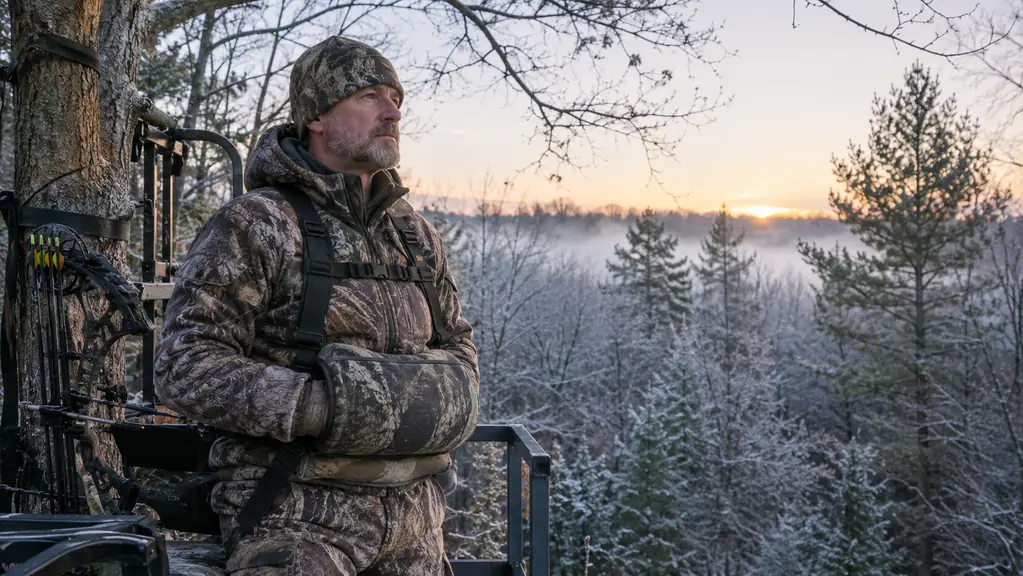
If you hunt whitetails in the Deep South, you know the real enemy isn't the deer. It's the cold that settles into your hands twenty minutes after you sit down, the kind that has you blowing on your fingers at first light and reaching for a disposable hand warmer packet by seven. I did that for years, stuffing those packets into my coat pockets and telling myself thin gloves were enough. Then, late in the 2024 season, I nearly slipped coming off the top of my ladder stand with my hands stuffed in my pockets. My son Cody talked me into upgrading my whole kit in the summer of 2025, and the Hunter Safety System Muff-Pak was part of that upgrade. After a full season of cold mornings in the stand, I've got some straight talk about it.
The Quick Verdict
The Muff-Pak does one thing better than anything else I've tried: it keeps your hands warm without locking them up. If you need to grab your bow, your rangefinder, or the rail of your stand fast, your hands are already out and free.
Amazon Check Today's Price →Stop blowing on your fingers at first light
The Hunter Safety System Muff-Pak is the simplest fix I found for cold hands in the stand. It's not a gadget, it's a fleece-lined pocket you wear, and it works. Check today's price on Amazon.
Amazon Check Today's Price on Amazon →How I've Used It
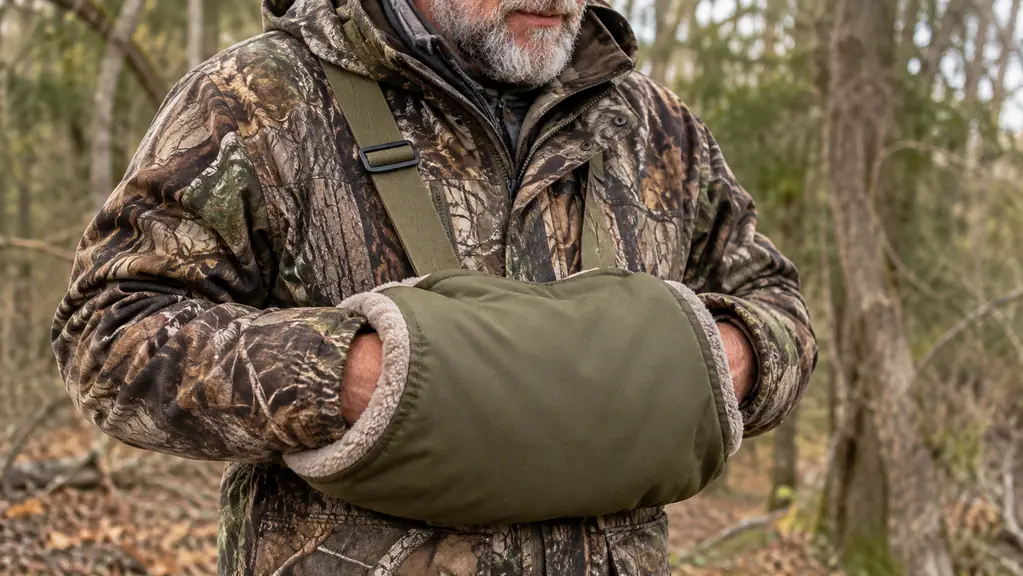
I bought the Muff-Pak in late summer 2025, before last deer season, along with the rest of my gear upgrade. It weighs 11.2 ounces, which is nothing once it's on. It's one size, and the included extender strap lets you wear it crossbody or adjust the length for a perfect fit. I wore it two ways: crossbody over my coat in the ladder stand, and around my waist in the ground blind. Both worked. The first time I put it on was a warm September afternoon, just to see how it rode. I clipped the strap, let it hang at belly height, and walked the yard for ten minutes. It didn't shift, it didn't bind, and it didn't get in the way of my arms. That was the whole test I needed. I set the length once and never touched the strap again.
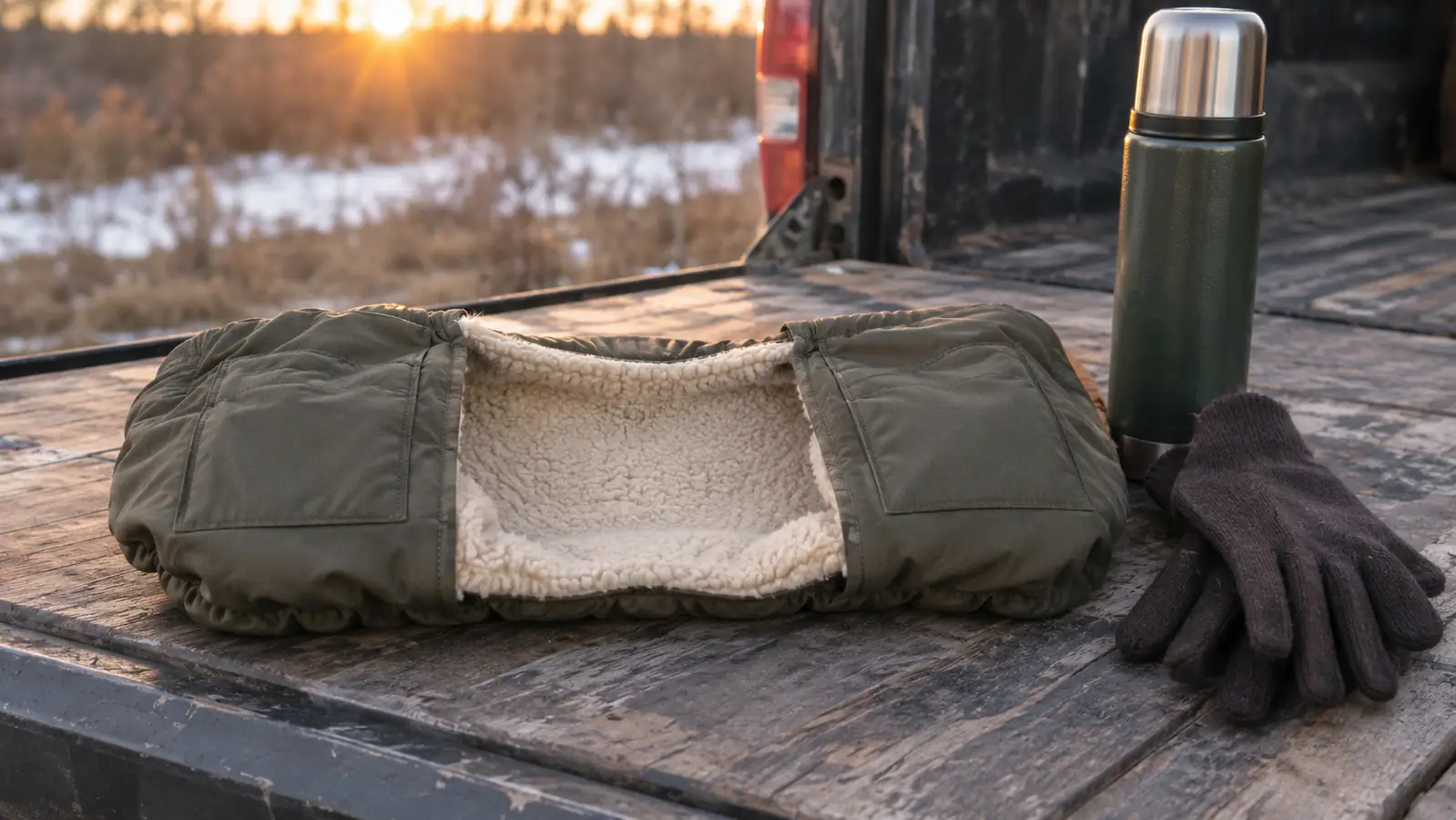
The design is simple. There's a fleece-lined center section where your hands go, and it has front and back pockets. The front pocket held my hand warmers on the coldest mornings. The back pocket, the one against your body, was where I kept my rangefinder. That turned out to be the feature I didn't know I needed. On a 28-degree morning, a rangefinder battery drains fast if it's sitting in a coat pocket. Kept against your body in that back pocket, it stays warm, and the glass doesn't fog when you pull it out.
I used it for the whole 2025-26 deer season from November through January, and then again for spring turkey in March and April. That's a full season of cold mornings, plus a few evenings that turned colder than the forecast said. The coldest sit was the morning of December 12, when the thermometer on the truck read 27 degrees at the gate and the pond behind the food plot had skim ice on it. I walked in with thin gloves, got settled in the ladder stand, and had my hands in the muff before the first gray showed. I remember that morning mostly because I forgot the hand warmer packet on the truck seat. It was the first cold morning I'd had without one, and I didn't miss it. The fleece alone was enough. My hands stayed warm through the whole sit, and when a doe worked along the edge of the pines at eight thirty, I had my rangefinder up and on her before she cleared the cedars. I took a good buck and a doe last season, and the Muff-Pak was on my waist for every one of those sits. It never failed me, and it never got in the way.
In the ground blind I wore it around my waist, which took some getting used to. In a ladder stand you sit still and the muff hangs in front of you. In the blind you're also sitting still, but you're tighter to the window, and a crossbody strap can catch on the arm of your chair when you lean to shoot. Around the waist it stayed put, and I could slide my hands in and out without looking. For turkey season I wore it mostly for the cold March mornings, when the gobblers were quiet and the sitting was long. By April I hardly needed it, but I kept it in the truck anyway. That's the thing about this piece of gear: once it's in the truck, it stays in the truck. Cody noticed it there one afternoon and asked how it had held up. When I told him I'd worn it on every sit, he just nodded. That's about as much as you get out of him on the subject of gear.
What the Muff-Pak Actually Does
Here's the thing that took me a while to understand: the Muff-Pak isn't a glove, and it isn't a hand warmer. It's a warm place to put your hands when you're not using them. That's it. And that's exactly what hunting from a stand requires. You don't need your hands doing anything for most of the sit. You need them ready to work the instant a deer steps out.
The center section is lined with polar fleece, and it does what polar fleece does: it traps your body heat and keeps the cold air off your hands. There's no battery, no chemical reaction, no moving parts. The included extender strap means you can wear it crossbody or adjust the length for a perfect fit, whether you're in a ladder stand, a ground blind, or sitting around a campfire. The product description mentions campfire use, and I believe it. This is the same logic as a hand muff my grandmother used at football games, just built for hunting. The difference is the pockets and the strap. My grandmother's muff was a tube of fake fur you rested your hands in. This one is built to stay on your body when you stand up, reach for something, or shift in your seat. That matters more than it sounds like it should. A hand muff that slides off your lap every time you move is worse than no muff at all, because now you're fiddling with gear when you should be watching the woods.
The front and back pockets are where the Muff-Pak earns its keep. The front pocket is right where your hands are, so it's the natural spot for a disposable hand warmer packet on the brutal mornings. I also kept a turkey call in there during spring season, a small diaphragm call in its case, and it rode fine without bulging. The back pocket sits against your body, which means anything you put in it stays at your core temperature. I kept my rangefinder there, and on the coldest mornings it made a real difference. Batteries last longer, and the display doesn't fog when you bring it up to your eye. I learned that the hard way early last season, when I left the rangefinder in my coat pocket on a cold November morning and spent a full minute trying to see through a fogged lens while a buck stood at the edge of the food plot. He was gone before I got the distance. After that, the rangefinder lived in the back pocket.
How It Performed Over a Full Season
The honest answer is that the Muff-Pak performed better than I expected, and it held up better than I expected. I wore it on at least forty sits last season, and it spent most of that time strapped to my body. It got rained on, it got dragged through briars on the walk to the ground blind, it got sat on in the truck, and it never showed a loose seam or a worn spot. The fleece inside stayed soft all season. That's not nothing. A lot of gear starts falling apart by January. I can point to the exact moment I stopped worrying about it: a Saturday morning in late December when I climbed down at the end of the sit and realized the muff had been hanging against the metal rail of the stand all morning. I'd been leaning on that rail for three hours, and the fleece didn't have a snag in it. If it had been one of the cheap muffs I'd seen at the discount store, it would have pulled apart at the seam.
The one thing I'd change is the material. The Muff-Pak is made of a polar fleece blend, and it works, but it's not waterproof. A steady rain will eventually soak it, and a soaked hand muff is worse than no hand muff because it's cold and heavy. I found this out on a wet December morning when a slow drizzle started about an hour after daylight. I pulled the muff under my coat, which meant unzipping my jacket every time I wanted my hands, and by the time I climbed down at nine the outside of the muff was damp and the fleece had lost its loft. It dried fine in the truck on the ride home, and it didn't shrink or stiffen, but I knew from then on to watch the sky. I handled this by keeping it under my coat on rainy mornings, which defeated the purpose a little. If Hunter Safety System made a version with a waterproof shell, I'd buy it in a heartbeat.
The other thing worth noting is that it's not a replacement for a good pair of gloves. There were mornings cold enough that I needed gloves to walk in, and the Muff-Pak doesn't help you walk. I used thin gloves for the walk in, then tucked my hands into the Muff-Pak once I was in the stand. That combination, thin gloves plus the Muff-Pak, was warmer than anything I'd used before, and it didn't cost me any dexterity. Before the upgrade, my system was the same thin gloves and disposable hand warmer packets, and it failed the same way every time: the packets went cold by nine, and I'd end up blowing on my fingers anyway. The Muff-Pak doesn't have that problem, because it's not trying to heat your hands. It's just keeping the cold off them, and keeping the cold off is the part that actually works.
The Muff-Pak kept my rangefinder warm in the back pocket on a 28-degree morning, and that alone was worth the price of admission.
Where It Shines
The Muff-Pak shines in exactly the situation I hunt in most: a long, cold sit in a ladder stand where you need your hands ready but not busy. When a buck stepped out at last light, I didn't have to fumble with a mitten or a hand warmer packet. My hands were already out of the muff and on my bow. That's the whole point, and it works. The best example came on a Saturday evening in early December. The wind had been wrong all day, and I'd convinced myself nothing was moving. I had the college game on the radio earpiece, low, and my hands were tucked in the muff, half watching the food plot and half listening to the third quarter. Then a buck materialized at the near edge of the pines, no sound, no warning, closing fast. My hands came out of the muff and were on the bow before I'd made the conscious decision to move. There was no glove to pull off, no packet to shove aside, no fumbling at all. The light was gone and he was quartering away, so I never took the shot, but the point stuck with me: the muff had done its job so well that my hands were ready without me thinking about it. That's the whole argument for this kind of gear in one story.
It also shines in the ground blind. There's less wind in a blind, but the cold still finds you, and the Muff-Pak is easier to use in tight quarters than a pair of bulky mittens. I wore it around my waist in the blind and it stayed out of the way of my shooting window. The front pocket held a hand warmer on the coldest mornings, and the back pocket held my rangefinder. It's a simple system, and it works. One thing I'll say for the blind: you have more room to move, so the crossbody strap never bothered me there either. I'd sit with my back against the corner, hands in the muff, watching the edge of the pines. On the mornings when the turkeys were quiet, which was most of March this year, the muff was the difference between a comfortable two hours and a miserable one. Sitting still is half of turkey hunting, and I could sit still longer with my hands warm. By the end of the season I'd stopped thinking about it entirely, which is the highest compliment I can pay a piece of hunting gear.
Who This Is For
This is for the hunter who sits still. If you're a bowhunter, a rifle hunter in a ladder stand, or a turkey hunter in a ground blind, the Muff-Pak is worth a look. It's also for the hunter who's tired of fighting with gloves. I've got a drawer full of gloves that were supposed to keep my hands warm and didn't. The Muff-Pak doesn't try to be a glove. It just gives your hands a warm place to live until you need them, and that's a better answer for most of my hunting. If you're the kind of hunter who's in the stand before daylight and still there when the woods go quiet, this is the simplest piece of comfort you can add to the kit.
Who Should Skip It
Skip it if you're a run-and-gun hunter who's always moving. If you're still-hunting through the woods, you need your hands free and you need gloves. The Muff-Pak is for sitting, not walking. Skip it if you hunt in a place where it rains all the time, because the polar fleece blend will eventually soak through. And skip it if you're looking for a gadget. This is a simple piece of gear. It doesn't do anything except keep your hands warm, and it does that very well.
What I Liked
- Keeps hands warm without locking them up, so you can grab your bow or rangefinder instantly
- Front and back pockets are genuinely useful, especially the back pocket for keeping a rangefinder at core temperature
- Lightweight at 11.2 ounces and comfortable for a full sit
- Extender strap lets you wear it crossbody or adjust the fit
- Held up through a full season of hard use without a loose seam
Where It Falls Short
- Not waterproof; a steady rain will eventually soak the polar fleece blend
- Not a replacement for gloves on the walk in or on the coldest days
- One size fits most, but bigger or smaller hunters may find the fit off
Give your hands a warm place to live this season
After a full season with the Hunter Safety System Muff-Pak, it's earned a permanent spot in my truck. If you sit still in a stand, you'll probably feel the same way. Check today's price on Amazon.
Amazon Check Today's Price on Amazon →