
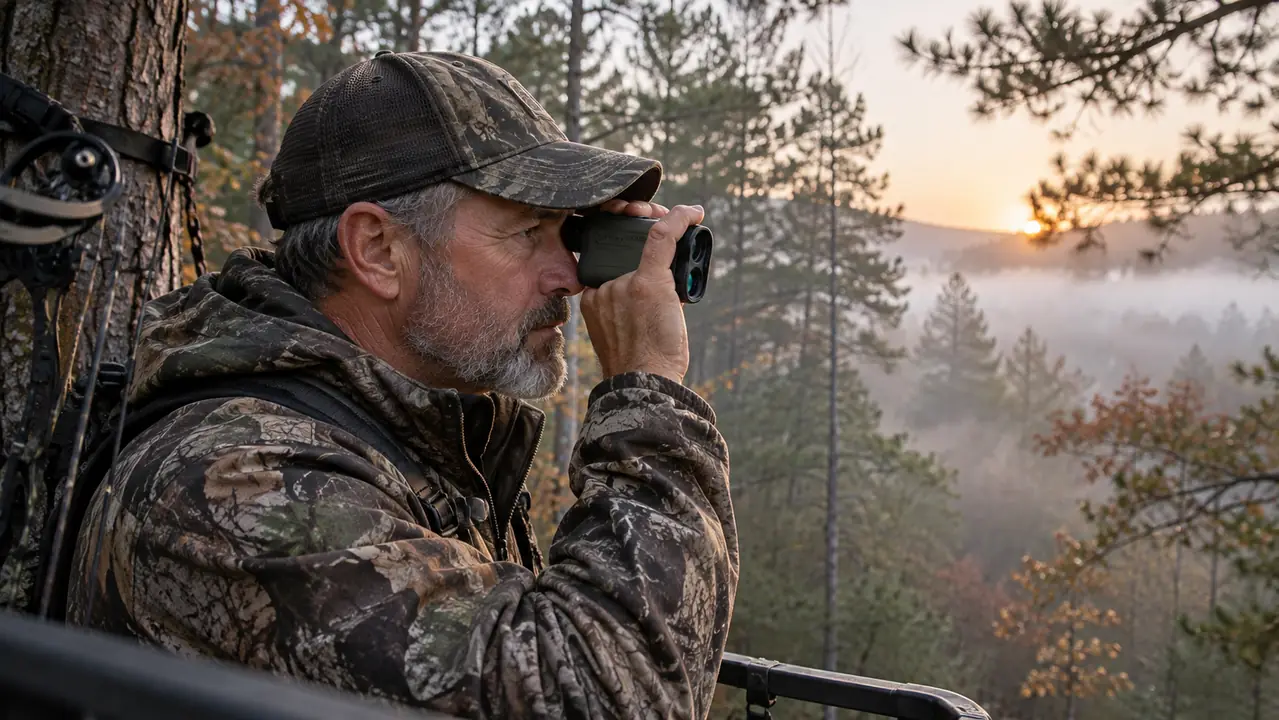
If you've read much about the Bushnell BoneCollector 850, you've probably seen the same two sentences everywhere: it ranges out to 850 yards, and it's made for deer hunters. Both are true. Neither tells you what it's actually like to carry in a ladder stand from November to January, then use it again for turkeys in March and April. I've done exactly that, and there are a few things I wish somebody had told me before I bought mine.
I'm Wade Pruitt. I'm 58, I've hunted whitetail and turkey for about 46 years, and I hunt a family lease of mixed pine and hardwood bottoms about an hour north of Mobile, Alabama. Last season I replaced the way I judge distance, and the Bushnell BoneCollector 850 is the rangefinder I carried every time I left the truck. This is the honest version of that review, including the parts the product page leaves out.
The Quick Verdict
The Bushnell BoneCollector 850 is a solid, no-nonsense rangefinder for deer and turkey hunting, with clear glass and fast scan mode, but it's not magic: it needs a steady hand past 350 yards, and the 850-yard rating only applies to reflective targets like buildings, not deer.
Amazon Check Today's Price →The rangefinder I carried all season
After a full season in the stand and the blind, the Bushnell BoneCollector 850 is the one I kept in my pack. It ranges deer quickly, reads well in low light, and never once let me guess. Check today's price on Amazon and see if it fits your setup.
Amazon Check Today's Price on Amazon →What Nobody Tells You About the 850-Yard Rating
The title says 850 yards, and that's the number everybody quotes. Here's the part that doesn't make it into the headline: that 850-yard figure is for reflective targets. A deer is not a reflective target. Neither is a tree trunk, most of the time. Bushnell rates this unit at 350 yards to deer and 500 yards to a tree, and in my experience those numbers are honest, maybe even a little conservative on a clear day.
What does that mean in the woods? It means the rangefinder is not the limitation on a typical Alabama deer hunt, because almost nobody I know takes a shot past 300 yards in these pine and hardwood bottoms. If you hunt out west where a buck can stand at 500 yards and stare at you, this is not the tool for that job, and you should know that before you buy. The 850 number sells the unit, but 350 to a deer is the number that actually matters, and it's a good one.
I put that 350-yard deer rating to the test one clear morning in the first week of December. A buck came out at the far end of the food plot, and I ranged him from the ladder stand. The unit read 341, then 344, then 340 as he fed along the edge. That's the far end of what it will do on a deer, and each reading took a couple of seconds with my elbows planted on the armrest. Inside 200 yards it's instant. Past 300, you need to be still. That's not a complaint. It's just the physics of a compact rangefinder, and it's the kind of thing you only learn by using one for a season.
The 500-yard tree rating is real too. One January afternoon I ranged a lone oak at the far edge of the hay field just to see if the unit would do it. It read 491, and it took a steady rest against the stand frame and about three seconds to settle. On a tree, that's fine. On a deer, three seconds is a long time, which is exactly why I never counted on the far end of the range for anything that could walk away.
How I've Used It
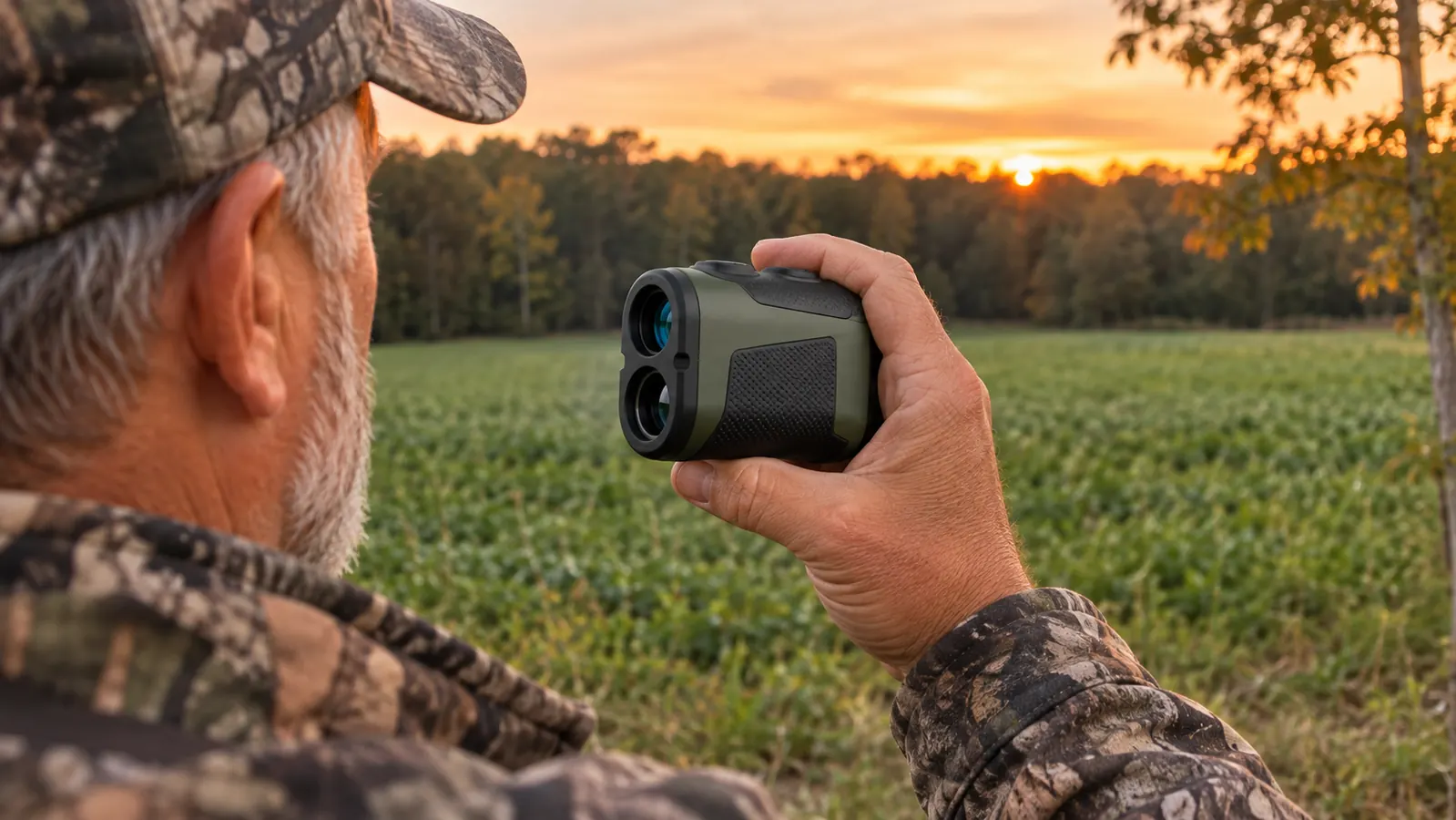
I bought the BoneCollector 850 in late summer 2025, before last deer season. It replaced a lifetime of guessing yardage by eye, which I'll admit I was never very good at. I used it from my ladder stand, from a ground blind, and for turkeys in the spring. That's one full season of deer hunting plus a spring turkey season, which is enough time to learn what a piece of gear actually does.
In the stand, my routine was simple. When a deer stepped out, I'd put the rangefinder on it, get a number, and then put the rangefinder down and pick up my rifle. That sounds obvious, but it's a real advantage: knowing the distance means I'm not dialing and guessing while a deer is staring at me. On public land and on the lease, that number was the difference between a clean shot and a bad one.
For turkeys, the unit worked differently. A turkey is a small target at 40 yards, and the scan mode earns its keep there. I could hold the button down and get a stream of numbers as the bird moved, which matters more than you'd think when a turkey is walking through scattered oak trees. I ranged turkeys, trees, field edges, and one very patient coyote, and the unit never gave me a number that didn't match the tape measure when I checked it back at camp.
The ground blind changed how I used it. From the ladder stand I've got the armrest to steady against. In the blind, I learned to brace the rangefinder against the corner post of the window opening, because a turkey at 50 yards is a small target and my hands are not what they were at 30. One morning in late March, a gobbler hung up at the edge of the oaks and wouldn't commit. I ranged him, then ranged the opening he'd have to cross, and when he finally stepped out I already knew the number. I didn't have to rush. That's the whole value of a rangefinder: it takes the guesswork out of the moment that matters. Cody watched me do this the first time and gave me a hard time about fussing with a gadget instead of hunting. Then he missed a bird he swore was close, stepped it off, and stopped giving me a hard time.
The 850 number sells the unit, but 350 to a deer is the number that actually matters, and it's a good one.
The Glass and the Body
Bushnell calls the optical system all-glass with fully multi-coated optics and ultra wide band coatings. What that means in the field is simple: the view through the BoneCollector 850 is bright and clear, even in the gray light of early November. I've used cheap rangefinders where the image looks like you're looking through a dirty window. This one looks like a decent set of binoculars, and that matters when you're trying to identify a buck's antlers at first light.
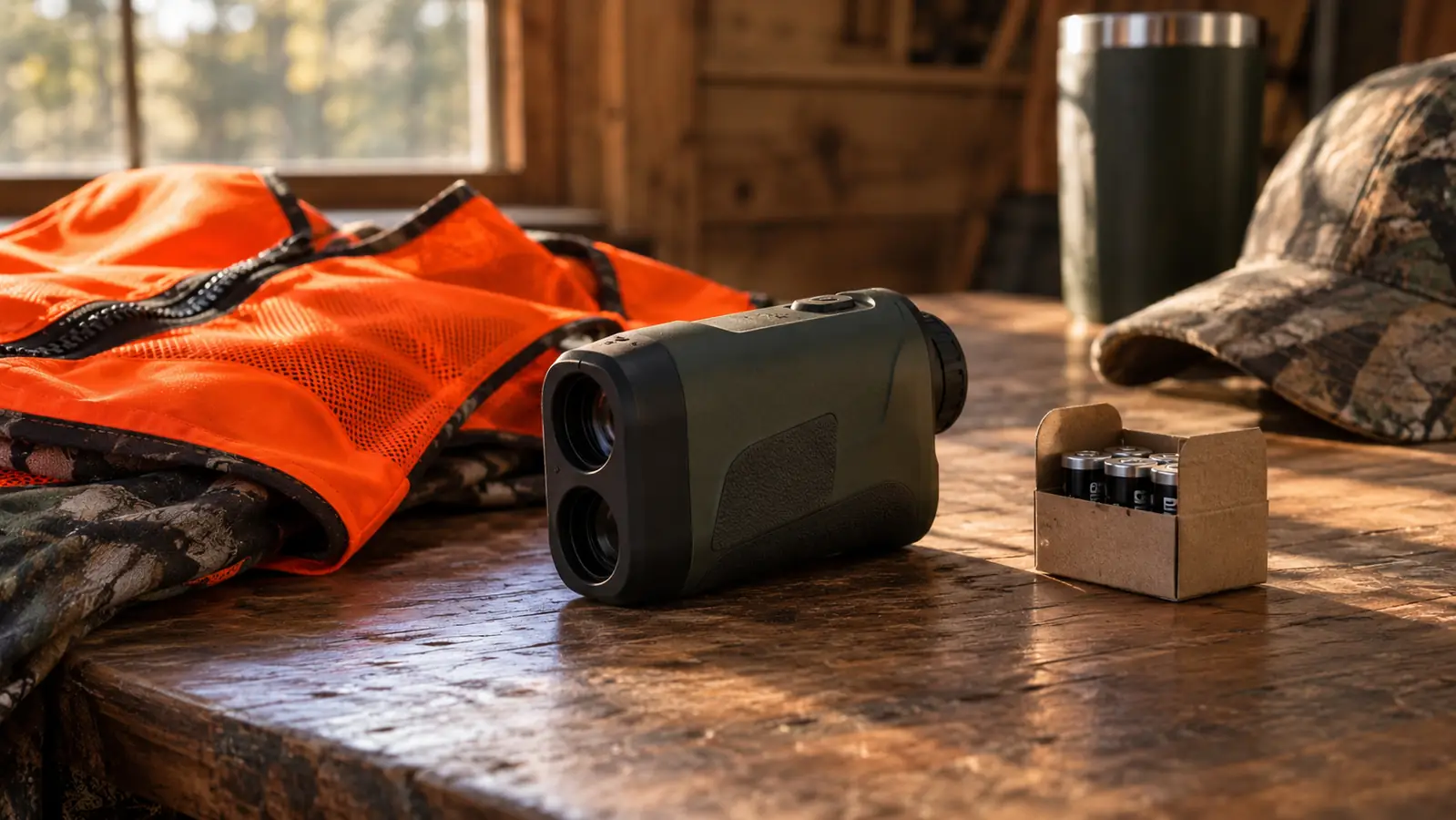
The magnification is 6x, and the objective lens is 24mm, which is a sensible combination for a hunting rangefinder. The body is plastic, and it weighs 180 grams. The dimensions are 3.19 inches long, 2.36 inches wide, and 0.98 inch thick. What those numbers mean in practice is that it disappears into the chest pocket of my hunting coat, which is exactly where I kept it. I forgot it was in my pack more than once, and I never once noticed it pulling on my coat or banging against the stand rail.
It's rated IP54 for water and dust resistance, and the spec sheet lists it as waterproof. I put that to the test in a way I didn't plan. One morning in mid-December, a cold rain moved in around nine o'clock and stayed all morning. The rangefinder rode in the outside pocket of my coat the whole time and got a real soaking. When I finally pulled it out to range a doe at the field edge, it powered up and gave me a number like nothing had happened. I dried it off at camp and it's been fine ever since. That's the waterproof rating earning its keep.
It takes a disposable 3V lithium CR2 battery. That's worth knowing before you buy, because CR2s are not the battery you have sitting in a drawer. I keep a spare in the glove box of my truck, because the last thing you want on a cold November morning is a rangefinder that won't power up. The unit came with a case in the box, which is a small thing, but it means the rangefinder has a home when it's not in your hand.
Scan Mode: The Feature That Grows on You
The feature list says the scan mode updates the range four times per second. That sounds like a spec sheet number until you use it on a walking deer. Hold the button down, and the numbers roll as the deer moves. It's the difference between getting one reading and watching the distance change in real time. For a hunter who's watched a buck quarter across a field, that's a genuine advantage, and it's the feature I'd miss most if I went back to a rangefinder without it.
The moment it clicked for me was a November afternoon when three does crossed the food plot in single file. I held the button down and the numbers walked with them, dropping from the 140s into the 130s as they closed. With a single-reading rangefinder I'd have had to lift, aim, read, lower, and repeat for each deer, and by the time I had the second number the first doe was in the trees. Scan mode is the difference between watching a situation develop and trying to keep up with it.
The tradeoff is that scan mode uses more battery than a single reading. I never killed a CR2 in a single season, but I also never went into the woods without a spare. A fresh CR2 will run this unit a long time. I started the season with one and swapped in the spare in February, not because it quit but because I didn't want to discover a weak cell on a cold March morning. You won't find CR2s in the checkout lane at the gas station, so I keep spares in the truck and in my pack.
Where the BoneCollector 850 Struggles
I said this would be honest, so here's the list. First, the 350-yard limit on deer is real, and it's the thing to know before you buy. If you hunt in open country where shots past 350 yards are routine, this rangefinder will frustrate you. It's not built for that job, and no amount of wishing will change it.
Second, the buttons are small, and they're not easy to operate with thick gloves on. The coldest morning I used it was 26 degrees with a north wind, and I was wearing a pair of insulated gloves I'd bought for the season. I couldn't feel the button through them. I ended up pulling my hand out of the glove to range a buck that was standing in the open, which is exactly the wrong time to be fumbling. I've learned to run the rangefinder before I put my gloves on, range what I need, and then get my hands back in the warm. It works, but it's a dance I didn't expect to learn.
Third, the plastic body, which is light and durable, does not feel as premium as a metal-bodied rangefinder. I'll be honest: the first time I picked it up, it felt lighter and less solid than the heavier units I've handled. A season later, I don't think about it. It never cracked, never creaked, and never let water in. The plastic is fine. It just doesn't feel like a premium product until you've used it for a while, and the light weight is exactly why I carried it on every single hunt.
What I Liked
- Accurate readings on deer out to the rated 350 yards, and the numbers matched my tape measure checks
- Scan mode updates four times per second, a real advantage on moving deer and turkeys
- Clear all-glass optics with fully multi-coated lenses; the view stays bright in low light
- Light at 180 grams and small enough for a coat pocket, so I carried it on every hunt
- Waterproof and IP54 rated; it took a full morning of cold rain without a hiccup
Where It Falls Short
- The 850-yard rating only applies to reflective targets, not deer, and that's easy to miss in the marketing
- Small buttons are hard to operate with thick gloves on cold mornings
- Plastic body feels less premium than heavier metal units, though it held up fine
- Past 300 yards it needs a steady rest, and the far end of the deer range is slow
Who This Is For
The Bushnell BoneCollector 850 is for the deer hunter who hunts the same woods I do: fields and bottoms where shots are inside 300 yards, mornings are dark, and a rangefinder needs to work fast and then get out of the way. It's for the hunter who wants to stop guessing yardage without spending a fortune or learning a complicated menu. It's for the turkey hunter who wants a quick number on a moving bird in the spring.
It's also for the hunter who wants a rangefinder that just works, season after season, without needing an app or a firmware update. There's something to be said for a tool that does one job and does it well. The BoneCollector 850 is that tool.
Who Should Skip It
Skip it if you hunt out west, or anywhere you routinely need a distance past 350 yards on an animal. Skip it if you need a rangefinder with angle compensation for steep mountain shots, because this unit doesn't have that feature. Skip it if you have serious trouble holding a rangefinder steady, because the far end of its range will frustrate you. And skip it if you want a rangefinder you can operate with heavy gloves on, because the buttons are small.
None of those are reasons the BoneCollector 850 is a bad product. They're reasons it's not the product for every hunter. Knowing the difference is the whole game.
The honest bottom line
After a full season, the Bushnell BoneCollector 850 is the rangefinder I'd buy again tomorrow. It ranges deer fast, reads well in low light, and never once made me guess. If that sounds like your kind of hunting, check today's price on Amazon.
Amazon Check Today's Price on Amazon →