
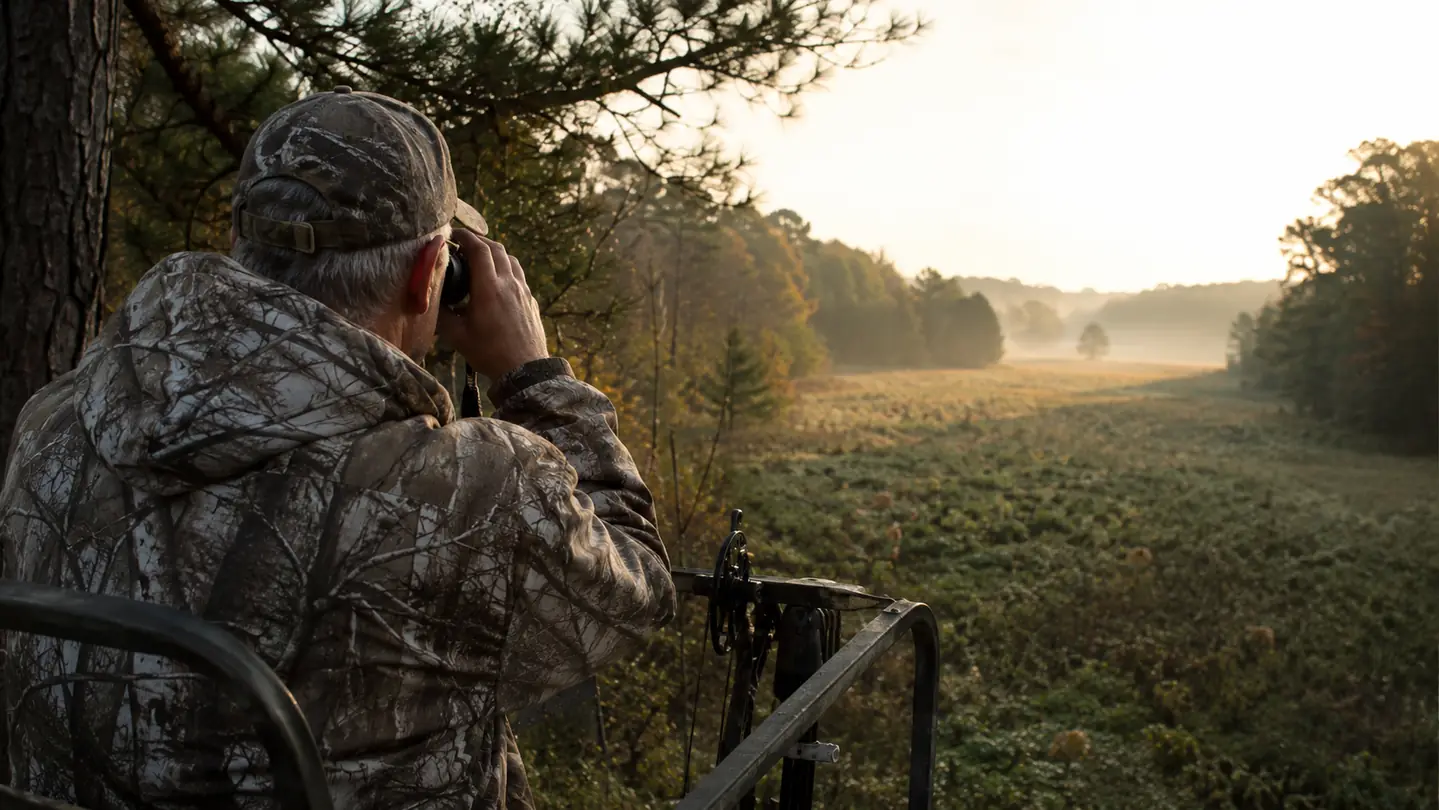
I have guessed yardage by eye from a ladder stand for more years than I care to count, and I have guessed wrong more times than I would ever admit out loud. From fifteen feet up, a deer at the edge of a food plot looks closer than it is. You hold a little high to be safe, the deer takes a step, and suddenly you are watching a deer walk off that you never had any business shooting at. That is the honest reason I finally bought the Bushnell BoneCollector 850 in late summer 2025, and it is the reason it rides with me on every sit now.
Most of my hunting happens from a ladder stand on a family lease about an hour north of Mobile, mixed pine and hardwood bottoms with a couple of food plots. I have hunted whitetail since I was twelve, so I have spent the better part of forty-six seasons learning to judge distance the hard way. The hard way means you range a deer at the moment it matters, with your heart beating and the light going, and you find out you were off by twenty yards. A rangefinder does not make you a better shot. It just takes one variable off the table, and from a ladder stand that variable is the one that lies to you most.
The rangefinder that finally took the guesswork out of my stand
The Bushnell BoneCollector 850 ranges deer out to 350 yards, trees to 500, and reflective targets to 850, with a scan mode that updates four times a second. After a full season in my ladder stand, it is the one piece of gear I will not leave in the truck.
Amazon Check Today's Price on Amazon →The BoneCollector 850 in My Stand
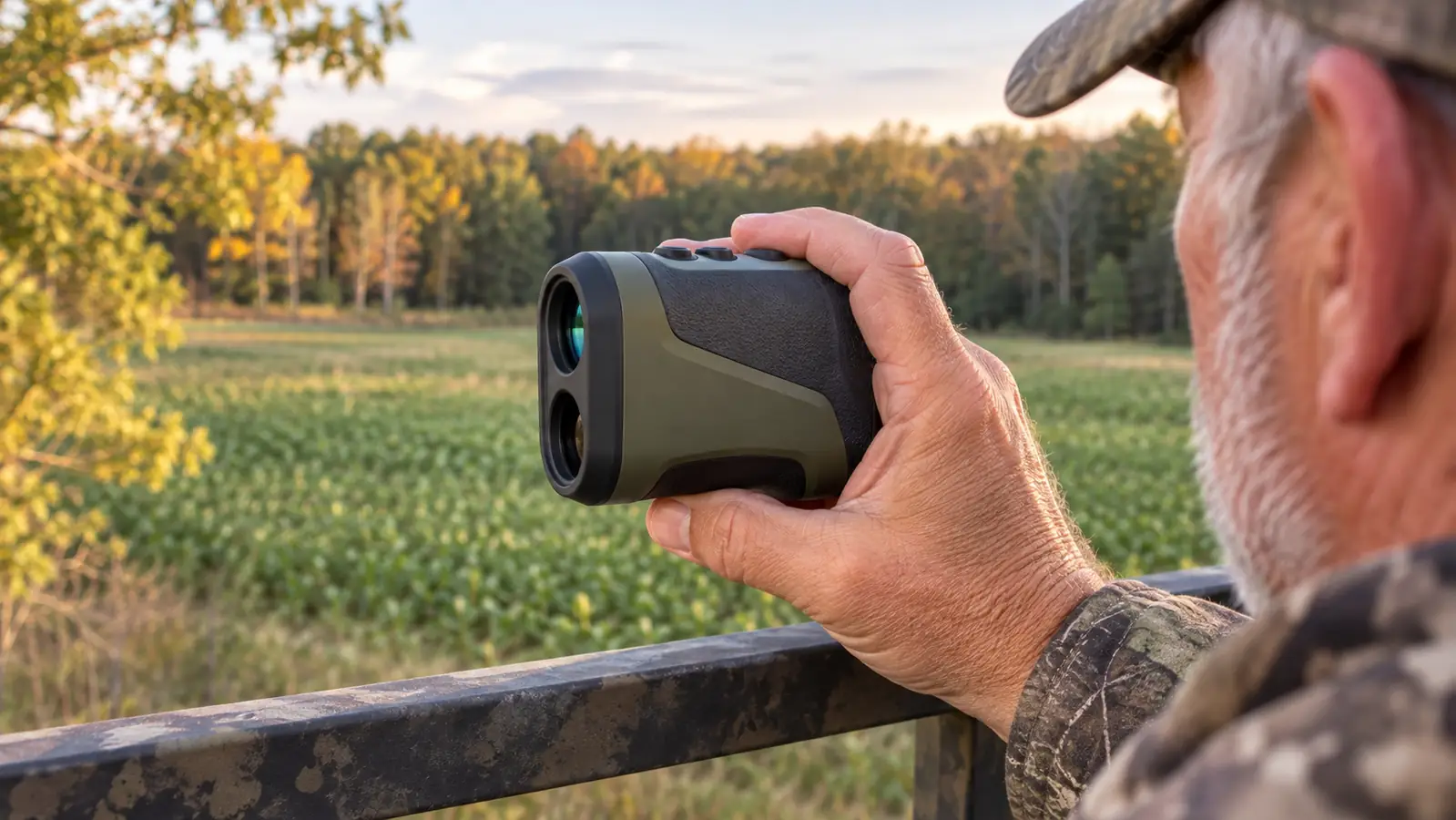
The BoneCollector 850 is a small unit, about three inches long and right at 180 grams, so it rides in its included case in my coat pocket until I need it. It is a 6x rangefinder with a 24mm objective, and the glass is the reason I bought it. Bushnell put their all-glass optical system and fully multi-coated lenses in it, and in the last gray light of an evening sit, that matters. It ranges deer out to 350 yards, trees to 500, and reflective targets to 850, which is more range than I will ever need on this lease, but it means the unit is never the limit. It runs on a single CR2 battery, it is waterproof, and it has a scan mode that updates the reading four times a second.
Step 1: Get Settled Before You Range
The first mistake most of us make is ranging before we are ready. You climb in, catch your breath, and the next thing you know you are leaning out over the edge of the platform trying to range a deer that is already walking. From a ladder stand, that lean is exactly how people get hurt. I strap into my harness before I do anything else, get my feet set, and let the stand stop swaying. A ladder stand moves with you, and a rangefinder in a moving hand will give you a reading you cannot trust.
When I am settled, I plant my elbows on my knees or against the stand rail and bring the unit up slow. The BoneCollector 850 has 6x magnification, so the target stays steady and easy to pick out. If I am ranging something far off, I take a breath, let it out halfway, and squeeze the button the way I would a trigger. It sounds like overthinking, but a steady rest is the difference between a reading you can bet on and one you are just hoping is close.
One more thing about settling in: do it before the woods gets quiet. On a slow sit I will range the same landmarks two or three times, just to keep the motion familiar. By the time a deer actually steps out, the rangefinder comes up without me thinking about it, and that is exactly what you want when the moment is short.
Step 2: Pick Your Landmarks in Good Light
Every stand has a handful of spots where deer actually show up: a trail crossing, a scrape line, the corner of a food plot, a particular blowdown. Before the daylight is gone, I range each one and burn the numbers into my head. That stump at the edge of the plot is 47 yards. The big pine where the trail comes out is 62. The far corner of the plot is 118. Once those numbers are locked in, I do not need to range a deer that is standing next to a landmark. I already know the distance.
This is where the 6x glass earns its keep. In low light, I can pick out a single branch or a specific stump instead of ranging the whole treeline and getting an average that means nothing. The fully multi-coated optics keep the image bright when the light is going. When I want to check a field edge, I hold the button down and let scan mode run. It updates four times a second, so I can sweep across the plot and watch the numbers change as I cross each landmark. That sweep is how I learned where the flat spots are.
I write the important numbers down the first time I range them, usually on a note card that stays in my coat. The memory is fine for a week, but by February, after a season of sits, the numbers blur. The card does not. It takes thirty seconds and it has saved me more than once on a morning when the fog was slow to lift.
Step 3: Learn the Numbers That Matter
The BoneCollector 850 will range a deer out to 350 yards, but that does not mean you should be shooting at 350. On my lease, most of my shots are inside 100 yards, and the stand gives me a clear lane maybe 150. The point of ranging is not to find out how far away a deer is. It is to know, before the deer ever steps out, exactly where your comfortable range ends. I range the far edges of every lane I can shoot, and I do not take a shot past the number I have already decided on.
Know what the numbers mean, too. The unit ranges reflective targets to 850 yards, trees to 500, and deer to 350. A deer is a poor reflector, which is why the deer number is the honest one. If you point it at a deer and get no reading, it is usually because the deer is moving or you are not on its chest. Aim at the middle of the chest, not the whole animal, and wait for the deer to stand still. That is the fastest way to a reliable number.
Scan mode helps here as well. If I am not sure which number to trust, I hold the button and let the unit update four times a second while I settle on the deer's chest. The reading will bounce a little, and the one that repeats is the one I use. A rangefinder that gives you the same number twice in a row is telling you the truth.
Step 4: Range the Deer, Not the Moment
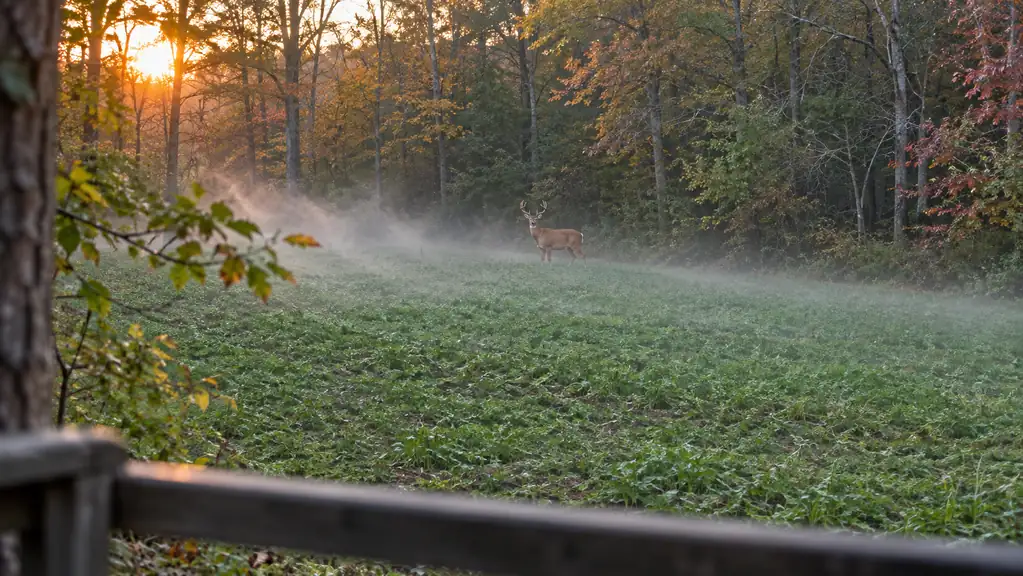
The hardest part of ranging from a ladder stand is not the mechanics. It is the moment. A buck steps out and everything in you wants to get the gun up right now. I have learned to do the opposite. I bring the rangefinder up first, get the number, and then make myself repeat it out loud before I touch the gun. Saying it out loud slows everything down and keeps me honest. If the deer is walking, I wait. A walking deer gives you a reading that is already wrong by the time you hear it.
When I do range a moving deer, scan mode helps. I hold the button down and track the deer, and the unit updates four times a second, so I can see the number settle as the deer slows. But the reading I trust is the one I get when the deer stops. That is when I repeat the number, find the deer in the scope, and decide. Most of the time the number is shorter than I thought it would be. From fifteen feet up, everything reads closer than it really is, and that is the lie a rangefinder catches.
It also helps to range the same deer twice if you have the time. The first reading gets your attention, and the second reading confirms it. Two readings that agree are worth more than one reading you are hoping is right. If the deer is nervous and you only get one clean look, take the number you got and trust the work you did in Step 2.
Step 5: Know What Is Beyond the Deer
Ranging the deer is only half the job. The other half is ranging what is behind it. I have hunted long enough to know that a deer does not always stop where you expect, and a miss that drops into a thicket is a deer you have to go find, or worse, a deer you never find. Before the season, I range every lane to its backstop, the dense stuff or the rise of ground that would stop a bullet. I range the backstop so I know, before the shot, whether there is anything safe behind the deer if I miss.
That is the part nobody talks about at the camp. A rangefinder is not just for the shot you take. It is for the shot you do not take. If the deer is standing in front of a gap in the treeline and I cannot range a safe backstop, I let it walk. I learned early to know my target and what is beyond it, and forty-six seasons have not changed that. The BoneCollector 850 makes that decision easy, because I can check the backstop in the same breath as the deer. Safety is not a separate step. It is part of the routine.
From a ladder stand, this matters more than from the ground, because your angle changes everything. A shot that would have buried into a hillside from a ground blind can skip over the top of it from fifteen feet up. So I range the backstop from the stand, at the height I will actually shoot from, not from the ground where it looks different. It takes an extra ten seconds and it is the most important ten seconds of the sit.
What Else Helps
Three small things make ranging from a ladder stand easier than it sounds. First, range before the season starts. I walked the lease in late summer with the BoneCollector 850 and wrote the key numbers on a note card that stays in my coat. By the time November came, most of the work was already done. Second, check the battery before you climb. The unit runs on a single CR2 battery, and a rangefinder with a dead battery is just a paperweight at the worst possible moment. I put a fresh CR2 in before the season and keep one in the truck. Third, keep the lens clean. A dusty lens will cost you light exactly when you need it most, and the all-glass optics are only as good as the glass you are looking through.
One more thing: practice with it from the stand, not just from the yard. The first time I used the BoneCollector 850 for real was in a ladder stand in low light, and I fumbled it because I had only ever used it standing on flat ground. Now I range a few landmarks every sit, even on slow mornings, so the motion is automatic. On the days when it matters, my hand already knows where the button is. That is the kind of boring practice that pays for itself in November. And on the slow sits, with the Saturday game on the radio earpiece, it gives me something useful to do with my hands.
I ranged that same field edge from the ground at 140 yards. From the stand it read 118. That twenty-two yard lie is exactly why I used to shoot over deer.
Stop guessing the yardage from your stand
A rangefinder will not make you a better shot, but it will take the guesswork out of the one number that matters most. The Bushnell BoneCollector 850 has done right by me for a full season in the ladder stand and the ground blind, and it is the piece of gear I will not leave in the truck.
Amazon Check Today's Price on Amazon →