
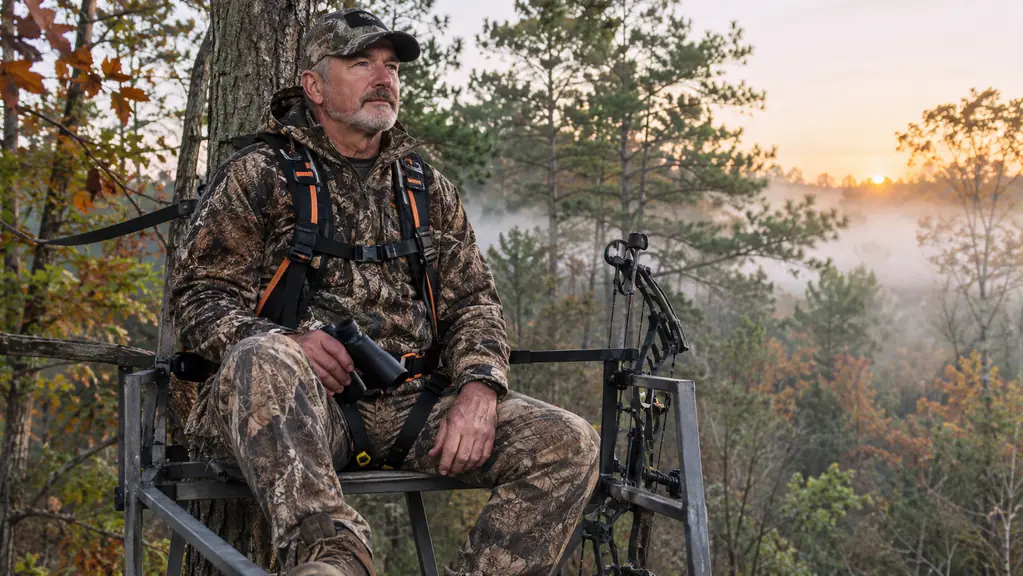
I spent 30 years as a lineman with a belt around my waist, and I will tell you straight: that belt is the wrong tool for a treestand. That is not a knock on the belt, because it is a fine tool for the job it was built to do. A lineman's belt is a positioning tool. It holds you against a pole so you can lean back and work with both hands. It was never built to catch a falling body. The Summit Treestands Pro Safety Harness was. I bought one in late summer 2025, after a near-slip coming off the top of my ladder stand shook me hard enough to finally listen to my son Cody, who had been telling me for two years to stop trusting the old waist belt I wrapped around the tree. I am 58 years old, I have hunted since I was 12, and I have climbed more poles than I can count. I am not a man who scares easy. That morning, I was scared. After a full season wearing the Summit Treestands harness, I can tell you the difference between the two is the difference between staying put and staying alive.
Short answer: if your feet leave the ground to hunt, buy the Summit Treestands Pro and leave the lineman's belt on the pole where it belongs. The harness has a torso strap and padded shoulder straps, a 300-pound weight capacity, a 1-year limited warranty, and it weighs 5.1 pounds. I wear the Large, which fits a waist size of 35 to 46 inches. The belt I wore for three decades at the power company does none of what this harness does. It was never rated to catch a fall, and neither was the old waist belt I used to wrap around the tree. The old belt is still in the garage, and it is going to stay there. Here is the why, and it comes from 30 years of climbing poles and 46 years of hunting out of stands. I am not guessing at any of this. I have trusted both of these things with my life, and only one of them earned it.
| Summit Pro Safety Harness | Lineman's Belt | |
|---|---|---|
| Fall arrest | Full-body harness catches a fall and spreads the force across your shoulders and torso | Positions you at the pole while you work, does not arrest a fall |
| Climbing into the stand | Buckled before you leave the ground, stays with you up the ladder, clips to the tree | Only works once you are at the tree, and only if it is snug around the trunk |
| Comfort on a long sit | Padded shoulder straps and a torso strap spread the load across your upper body | A waist belt digs into your midsection the moment you lean forward to watch |
| Weight | 5.1 pounds, part of your normal climb | A simple belt is lighter and easier to carry up the ladder |
| Learning curve | Takes a few trips to get the fit right | You already know how to use it, and that familiarity is exactly what makes it dangerous |
| Warranty | 1-year limited warranty | Old work gear, no warranty, no fall rating |
| Best for | Hunters who climb into a stand before daylight | Linemen working a pole, and nobody else |
Where the Summit Pro Wins
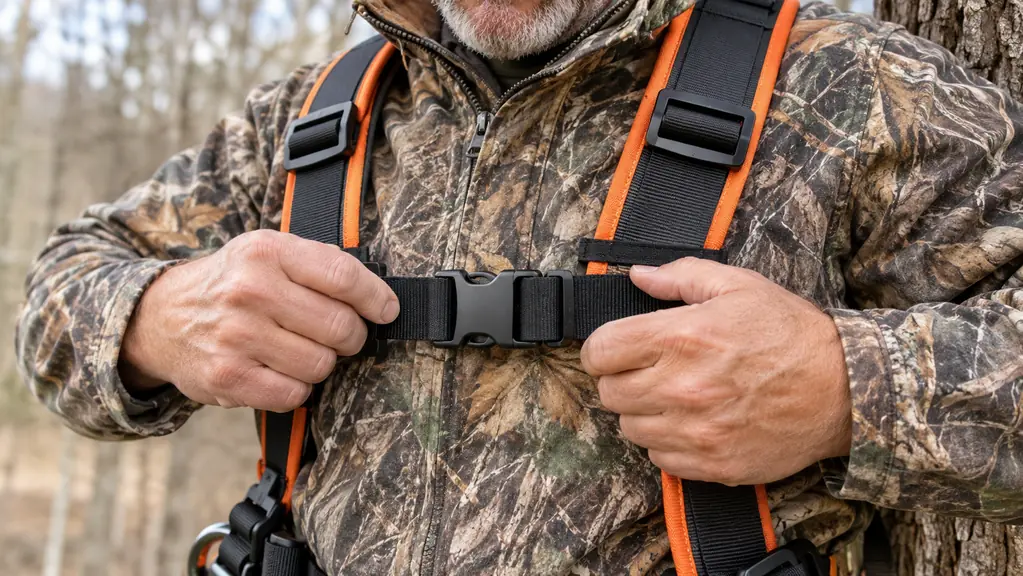
The Summit Treestands Pro wins where it counts: the moment you slip. A lineman's belt is built to let you lean back against a pole and work with both hands, and that is all it is built to do. In 30 years on the job, I never once heard of a belt catching a man who fell. When a man slipped on my crew, it was the lanyard and the full-body harness that caught him. The belt just kept him positioned until the fall started, and after that it was just along for the ride. The Summit Treestands Pro is a different animal. The torso strap and the padded shoulder straps are there to spread the force of a fall across the strong parts of your body, not to concentrate it on your waist. That is the entire point of a full-body harness, and it is the entire reason I wear one in the stand now. It is rated to 300 pounds, which covers me and everything I carry up the ladder. That rating matters, because a fall does not care how experienced you are. It does not care how many deer you have killed or how many poles you have climbed. It just cares about physics, and physics says a waist belt is the wrong thing to trust. I have seen what a fall does to a man who thought he was too careful to fall.
The comfort argument is just as real, and comfort is a safety feature, not a luxury. I sit from first light until mid-morning, and on slow days I stay until the middle of the day. The padded shoulder straps sit on my shoulders like the straps of a pack, and the torso strap keeps everything where it belongs. I forget it is on, and that is the highest praise I can give any piece of safety gear. The old waist belt around the tree never let me forget it. It slid down the trunk on a damp morning. It dug into my midsection when I leaned forward to watch a scrape. And it gave me a false sense of security that I am ashamed to admit I trusted for years. The military-inspired MOLLE attachment system on the Summit Pro is a bonus. I can carry a small pouch on it, which means one less thing in my pockets on the walk in. When the harness gets muddy, I hand wash it with mild soap and let it air dry, and it comes out good as new. A harness you do not mind wearing is a harness you will actually wear, and that is the whole ballgame. The safest harness in the world is useless hanging on a hook in the garage.
Where the Lineman's Belt Wins
I will give the lineman's belt its due, because I wore one for 30 years and it earned its place on my hip. It is lighter than a 5.1-pound full-body harness. It has zero learning curve: if you have worked a pole, you know how to set it, snug it, and trust it without thinking. And if you already own one, it is hanging in your garage right now, which makes it the easiest piece of safety gear in the world to grab on the way out the door. On those three points, the belt wins, and I am not going to pretend otherwise. Weight, familiarity, and convenience all go to the belt. If the only question were which one is easier to carry up a ladder, the belt would win every time, and I would tell you so. I spent three decades wearing one, so I am not knocking the tool. The belt never lied to me. I just asked it to do something it was never built to do.
But here is what 30 years on the job taught me, and it is the part that matters most. A lineman's belt never once kept me from falling. It kept me positioned so I could work. When a lineman slipped on a wet crossarm, it was the lanyard and the full-body harness that caught him, not the belt. The belt was just what he leaned back on. That is the trap with using one around a tree. It feels like safety because it is familiar, and familiar is not the same as safe. The near-slip that ended my 2024 season happened coming off the top of my ladder stand, with my old waist belt snug around the tree. The belt did exactly what it was built to do, which was nothing, because I was not leaning against it. I was stepping down, one slick boot sole away from a fall that the belt would not have slowed, let alone stopped. I climbed down that morning with my heart pounding, drove home, and ordered the Summit Treestands Pro that same week. Cody was right, and I told him so. I have replayed that morning a hundred times, and every time the ending is the same: nothing catches you except the ground.
In 30 years on the job, a lineman's belt never once caught a man who fell. The lanyard and the harness did.
What a 30-Year Lineman Tells Every Hunter at the Lease
If you climb into a stand, wear a real harness. The Summit Treestands Pro Safety Harness is the one I trusted all last season and the one I will climb with again this fall. It is rated 4.8 out of 5 by 739 hunters, and it carries a 1-year limited warranty. Check today's price on Amazon and see why I stopped trusting a belt.
Amazon Check Today's Price on Amazon →
Who Should Buy Which
Buy the Summit Treestands Pro if you hunt from a treestand, period. That includes you if you are young and bulletproof, because I was you, and I am here to tell you that the one time you need a harness is the one time you will not have time to grab the tree. It is right for ladder stands, climbing sticks, and lock-ons. It is right for the 5 a.m. climb in the dark and the cold, wet descent at the end of a long sit. If your feet leave the ground to hunt, you need a full-body harness, and the Summit Treestands Pro is a good one. Cody has his own gear, and when I bought mine in the summer of 2025 I told him the same thing I am telling you: the belt I used to wrap around the tree never should have been trusted, and the harness is the reason I still climb into a stand at 58. I have hunted for 46 years, and I plan to hunt for a good while longer. That only happens if I come down the same way I went up. A harness is like a seatbelt. You do not wear it for the trips where you need it. You wear it for the one trip where you do.
Keep the lineman's belt for the pole. If you still climb poles for a living, wear your belt the way your employer trains you, with the proper lanyard and the full-body harness that goes with it, the way I did for 30 years. If you are a hunter who happens to own an old belt from a previous life, leave it in the garage. It is not a treestand safety device, and no amount of experience changes the physics of a fall. The belt positions you. The harness catches you. Those are two different jobs, and confusing them is how hunters end up in the hospital, or worse. I say that as a man who trusted the wrong one for too long and got lucky. Luck runs out, and I would rather run out of luck at the deer camp than at the bottom of a tree. The hospital is full of hunters who knew better, and I do not want to be one of them.
The way I look at it now, the belt is a work tool and the harness is a hunting tool. I carried one on my hip for three decades, and I will not carry it up a tree again. The Summit Treestands Pro goes up the ladder with me every hunt, buckled before I leave the ground and clipped to the tree before my boots leave the platform. That routine takes thirty seconds, and it is the best thirty seconds of my hunt. It is also the only reason Linda still lets me climb into a stand at my age, and I am fine with her keeping an eye on me. She is not a hunter, but she knows a fall from a treestand does not care how long you have been doing this.
If you are still on the fence, think about it this way. The harness works whether you are leaning, sitting, climbing, or stepping. The belt works only when you are leaning against it, and a treestand is not a pole. You do not lean back against a ladder stand. You sit in it, you stand up to shoot, and you step off the platform when the hunt is over. Every one of those moments is a moment the belt is not doing anything for you. The Summit Treestands Pro is doing something for you in all of them.
One Near-Slip Was Enough for Me
The Summit Treestands Pro Safety Harness is the last piece of safety gear I will ever need in a stand. It is rated for 300 pounds, it is covered by a 1-year limited warranty, and after a full season it still fits like the day I bought it. Check today's price on Amazon and climb with both hands free.
Amazon Check Today's Price on Amazon →