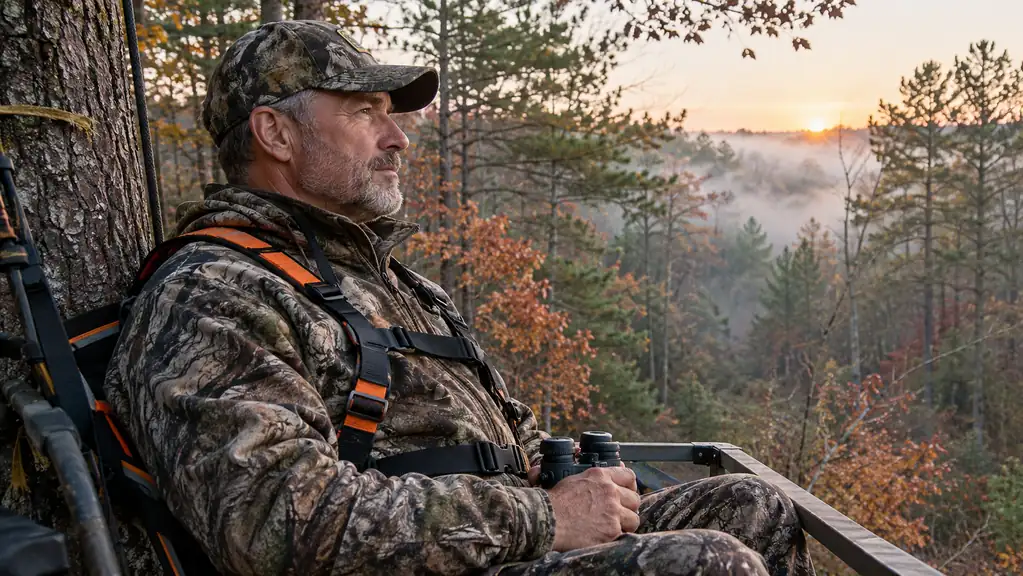
I climbed with an old waist belt for more years than I like to admit. It buckled around the tree, and the idea was that if you slipped, you would catch yourself on it. The problem is that a waist belt does not catch you. It lets you slide out of it, or it flips you upside down, and neither of those ends well. I knew better, and I used it anyway, because it was what I had. I came close to paying for that at the end of the 2024 season, coming off the top of my ladder stand. I did not fall, but I grabbed the rail hard enough that my shoulder ached for a week, and my son Cody made me promise to upgrade the whole safety kit before the next season. The first thing I bought was a Summit Treestands Pro Safety Harness.
This is the part of hunting that sounds like a lecture, so I will keep it short. I spent 30 years as a lineman, and I will tell you what I told every guy on the crew: gear only works if you use it the way it was built to be used. A full-body harness is not a seatbelt you buckle once and forget. There is a right way to put it on, a right way to climb with it, and a right way to stay attached once you are at hunting height. Before last season I climbed with a waist belt I should have thrown away years earlier. This is the system that replaced it, and here is exactly how I use it, every hunt, in the same order, until it is muscle memory.
The harness that replaced my old waist belt
The Summit Treestands Pro Safety Harness is the first thing I grab out of the truck. Padded shoulder straps, a torso strap that holds everything snug, and a MOLLE attachment system for the small stuff. It earned its spot after one full season.
Amazon Check Today's Price on Amazon →Step 1: Inspect everything before you leave the truck
I do this at the tailgate, not at the tree. The harness gets a full once-over: every buckle, every strap, no frayed webbing, no worn parts. The stand gets the same. Ladder rungs, the platform, the straps that hold the stand to the tree. After 30 years as a lineman, I can tell you that inspection is not a chore. It is part of the job. If something looks wrong at the truck, it will only look worse at 20 feet up.
The Summit Treestands harness is rated for 300 pounds, which covers me and then some. The webbing is still in good shape after a full season, and the buckles click clean. The Large size fits a 35 to 46 inch waist, so there is room to adjust it over heavy winter layers. It is covered by a one-year limited warranty, and the care instructions are simple: hand wash with mild soap and air dry. I have not needed the warranty yet, but I like knowing it is there. I check the fit at the truck too, before my hands are cold and the light is going.
I also check the tree before I ever strap a stand to it. I only hunt from live trees, and I look for rot at the base and where the stand straps wrap around the trunk. A good harness will not save you if the tree comes down, so the tree gets the same respect as the gear. That is not a lecture. It is a habit that costs two minutes.
Step 2: Put the harness on with your feet on the ground
The biggest mistake I see is guys who put the harness on after they are already up the ladder. That means the most dangerous part of the climb, the first ten feet, happens with no protection at all. I put the harness on at the truck or at the base of the tree, before I touch the ladder. It takes two minutes, and it turns the whole climb into a safe one.
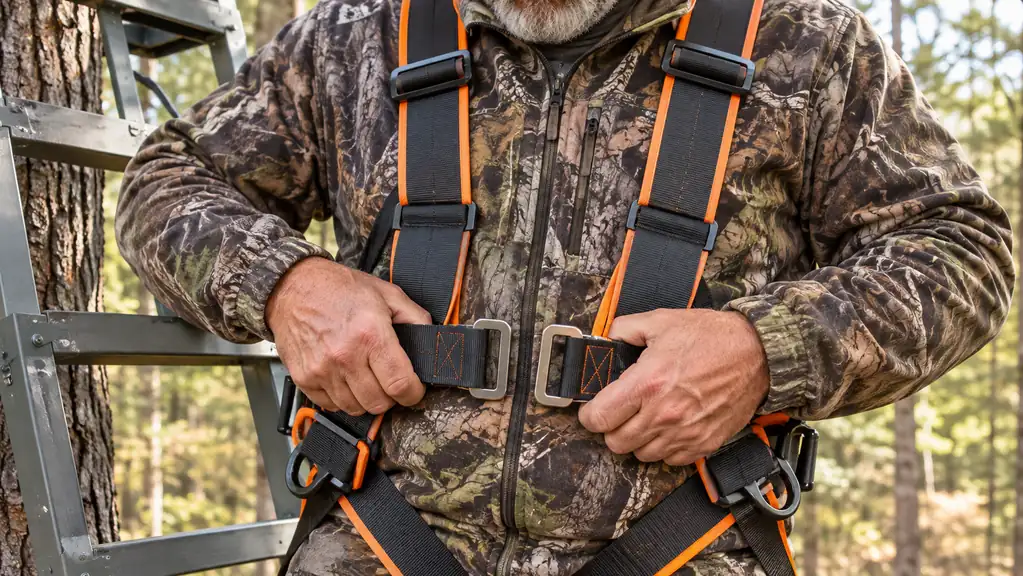
The Summit Treestands Pro Safety Harness goes on like a set of overalls. The padded shoulder straps sit where they are supposed to, and the torso strap pulls everything snug so nothing rides up when you move. The Large size gives me room over a base layer and a jacket. I tighten it until it is firm but not fighting me, then I do a quick squat test to make sure nothing binds. The whole rig weighs 5.1 pounds, so you know it is on you during the climb, but I stop noticing it after the first ten minutes in the stand.
Then I clip my climbing strap to the harness before I start up. That belt is a separate piece of gear, but it is the bridge between the harness and the tree. If you have never used one, practice at ground level first. It takes ten minutes to get the hang of it, and it is the difference between climbing nervous and climbing easy.
Step 3: Stay attached the whole way up
Here is the part that surprises people: the climb is the most dangerous part of hunting from a ladder stand. You are carrying a bow or a rifle, you are looking up instead of at your feet, and you are tired from the walk in. A climbing strap lets you stay clipped to the tree for every step. You slide the belt up the trunk as you climb, and you are never more than a few inches from being caught. It sounds like extra work, but after one climb you will not want to do it any other way.
I climb slow, and I climb the same way every time. Right hand on the rail, left hand on the belt, feet one rung at a time. I do not carry anything in my hands. My bow goes up on a pull rope after I am seated, and my pack goes up the same way. I keep the pull rope tied to the platform so I can send the bow up before I am fully seated, and lower it the same way when the hunt is over. That is not just convenient. It is the difference between a clean climb and a fall.
The MOLLE webbing on the Summit Treestands harness is handy here because it gives you a place to hang small things you want within reach, like a rangefinder pouch, without threading them through your coat. Just keep the front of the harness clear so the climbing strap clips clean every time.
Step 4: Hook the tether before you sit down
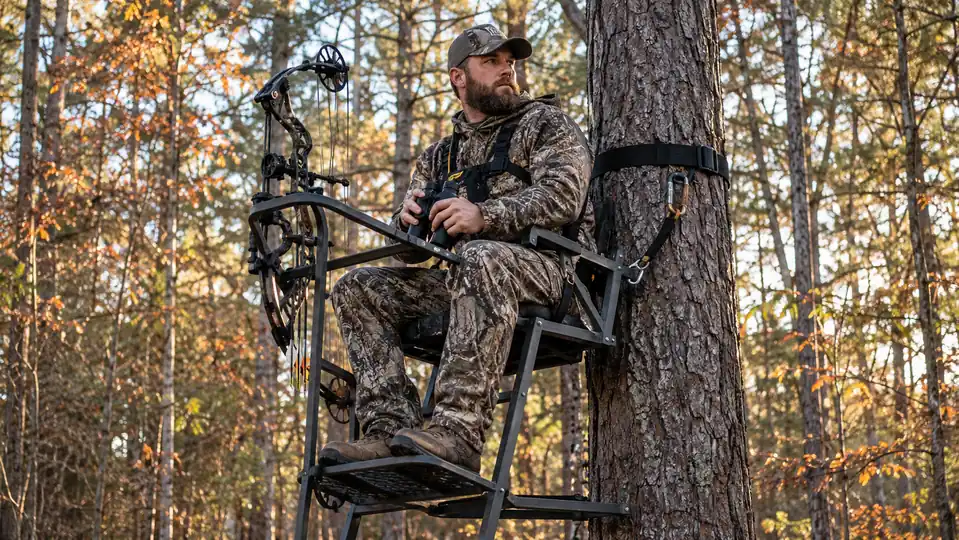
When you get to the platform, the job is not done. The climbing strap gets you up the ladder, but once you are at hunting height you need to be attached to the tree with a tether. I run a tree strap around the trunk at head height, clip the tether to the harness, and then I sit down. The tether stays hooked from the moment I step onto the platform until my feet are back on the ground.
This is where a full-body harness earns its keep. If you slip off the platform, the harness catches you, and because the torso strap holds everything snug, you stay put instead of sliding out. I know because I tested it low to the ground before I ever trusted it at height. I clipped in, leaned out until the tether caught me, and let it hold my weight. It worked exactly like it was supposed to. I have shown Cody how to do the same test, because a harness you have never trusted at ground level is a harness you will hesitate to trust at height.
The other thing I do is take the slack out of the tether. A loose tether means you can fall a few feet before it catches you, and that is a few feet you do not need. I tighten mine so I can lean forward and shoot, but I cannot get more than a few inches out of the seat without feeling the tug.
Step 5: Stay attached all the way down
Getting down is where I almost got hurt, and it is where most guys get careless. You have been sitting for hours, you are cold and stiff, and you just want to be on the ground. That is exactly when the climb down needs your full attention. I reverse the process exactly: unhook the tether, clip on the climbing strap, and keep it clipped for every rung until both feet are on the ground. I do the same thing in the dark, because the last hunt of the day is the one where I am most tired.
The near-slip that started all this happened coming off the top of my stand at the end of the 2024 season. I was in a hurry, it was late, and I reached for the ladder before I was ready. I caught myself, but it was close enough that I sat down on the platform for a minute and let my heart catch up. Cody heard about it that night, and he told me the waist belt had to go. He was right.
Now the rule is simple: the ground is the only place I unhook. Not the last rung. Not the platform. The ground. It costs me ten extra seconds a hunt, and it is the cheapest insurance I own. Cody watched me do it all season, and by February he was doing it without thinking.
What Else Helps
A harness is the centerpiece, but it is not the whole system. I tell Cody the same thing I tell anyone who hunts with me: tell somebody where you are and when you will be back. Linda knows which stand I am in and what time to expect the truck at the house. I keep a radio earpiece in the stand for Saturday games, and it doubles as a way to check in without pulling out my phone. I clear leaves and limbs from the base of the stand every time I set up, so the landing zone is as clean as I can make it. And I wear blaze orange where the regs call for it, because the best harness in the world will not help you if someone mistakes you for a target. Know your target and what is beyond it, and follow your state's regulations.
The other thing that helps is practice. I spent an afternoon before last season doing dry runs at ground level: putting the harness on, clipping and unclipping the climbing strap, hooking the tether. By opening morning it was muscle memory, and muscle memory is what you want when it is dark, it is cold, and you are half awake.
Every season I climb the stand with a wrench and check every bolt and strap before I ever hunt from it. The stand has been on the same tree for years, but weather works on hardware, and hardware does not care about your plans.
The old waist belt would have dropped me like a sack of feed. The Summit Treestands harness is the reason I still climb at 58.
One season in, I would not climb without it
The Summit Treestands Pro Safety Harness has a full season of climbs behind it and a permanent spot in my truck. Padded shoulder straps, a snug torso strap, MOLLE attachment points, and a 300-pound rating. If you still climb with a waist belt, this is the upgrade.
Amazon Check Today's Price on Amazon →