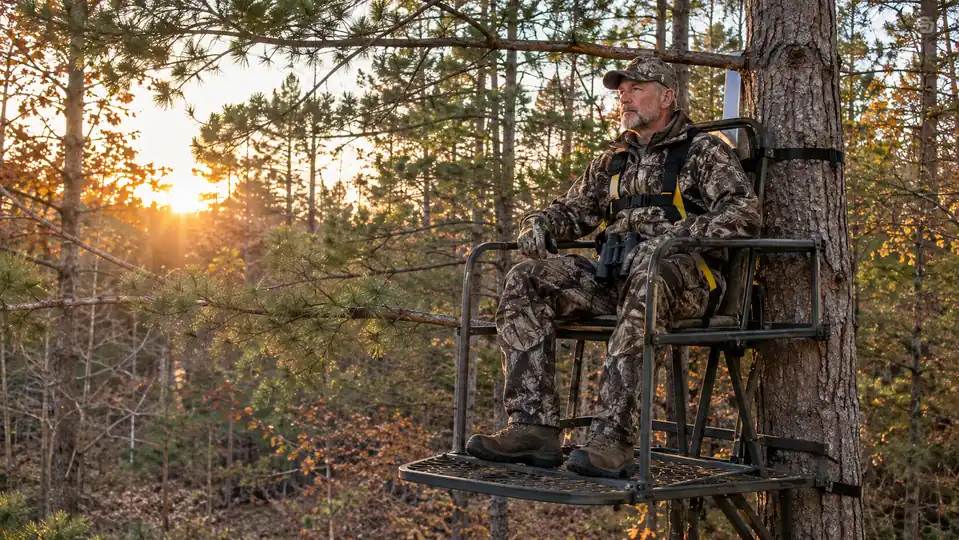
I spent 30 years climbing utility poles with a leather belt and a set of climbers, so I have an opinion about safety straps that most deer hunters do not. When I tell you the old waist belt I used around the tree for years was a gamble, I am not guessing. I know exactly what a fall does to a man who is tied off wrong, and I have the scars on my hands to prove the job taught me respect for it. This past season I hunted with the Summit Pro Safety Harness from Summit Treestands, and I have some honest things to say about it that the product page will not tell you.
The short version is this: it is the harness I trust enough to wear every time I climb into my ladder stand, and it is also heavier and hotter than you expect, with a learning curve that will make you cuss it the first three times you put it on. Both of those things are true. If you want the full story from a retired lineman who has worn worse for 30 years, keep reading.
The Quick Verdict
The most secure, most comfortable full-body harness I have used in 46 years of hunting, but it runs warm, takes practice to put on, and the 5.1-pound weight is real when you are packing it in.
Amazon Check Today's Price →The harness I trust enough to wear on every single climb
After a full season in a ladder stand, the Summit Pro Safety Harness is the one piece of gear I will not leave in the truck. Check today's price on Amazon before you buy anything else.
Amazon Check Today's Price on Amazon →How I've Used It
I bought the Summit Pro Safety Harness in late summer 2025, before last deer season. The reason was not that I woke up one day and decided to be careful. It was that near the end of the 2024 season, I slipped coming off the top of my ladder stand and caught myself with one arm wrapped around the tree. It happened fast, the way those things always do, and I sat on the ground for ten minutes before my heart slowed down. My son Cody, who hunts with me most weekends, told me I was done with the old waist belt and that we were upgrading the whole kit at once. He was right, and I knew it. The old belt had been on that tree for years, a simple strap with a buckle that I had trusted since before Cody was old enough to hunt, and I can tell you exactly why it failed me: it sat at my waist, so a fall would have bent me backward over the buckle instead of catching me across the chest. That is a lesson I learned in the utility trade, and I ignored it for years because the belt was familiar. That slip was the wake-up call I needed.
So I have used this harness for exactly one full season: the 2025-26 deer season from November to January, plus the spring 2026 turkey season in March and April. That is somewhere north of 40 sits, most of them in my ladder stand on the family lease about an hour north of Mobile, some of them on public land. I wore it on cold November mornings when the temperature was in the high twenties, and I wore it on warm April afternoons when I was sweating through my shirt. I have worn it over a heavy coat, over a light jacket, and once over just a long-sleeve shirt when the weather turned warm. I have sat in it for four straight hours without moving, and I have climbed in and out of the stand with it on. That is the kind of use that finds the flaws.
The harness is a large, and the sizing is honest: Summit Treestands lists the large at a 35 to 46 inch waist, and I found that accurate. I wear a 38 waist in blue jeans, and the large fits me with room to spare over a heavy coat. My son Cody, who is 31 and wears about a 34 waist, tried it on once and it was too big for him. That is not a flaw in the harness. That is a sign to read the sizing chart instead of guessing, because the medium and large do not overlap much. The specs also list a 300-pound weight capacity, which covers just about any hunter I have ever climbed a tree with, and a 1-year limited warranty, which is honest for a piece of gear that takes this much abuse.
What Nobody Tells You Before You Buy
Here is the honest part, the stuff the product page leaves out. First, the weight. The specs list the harness at 5.1 pounds, and that number is real. When you hold it in your hands, it feels like a tool, not like a piece of clothing. In my climbing days I carried a lot more than five pounds on my belt, so I did not flinch at it, but a hunter who is used to a two-pound waist belt will notice the difference on a long walk to the stand. It rides heavy on your shoulders before you even get to the tree. My stand sits a good 250 yards off the two-track, most of it uphill through the pines, and on a cold morning I carry my pack, my rifle, and this harness. By the time I reach the tree I am breathing hard. But here is the trade I made peace with: the walk takes me ten minutes, and the climb takes me thirty seconds. I would rather be winded at the base of the tree than dead on the ground.
Second, it is warm. The torso strap and the padded shoulder straps are comfortable, and I mean genuinely comfortable, but comfort and ventilation are two different things. On a 40-degree morning it is fine. On a 70-degree April afternoon, it is a heat trap. I sat through a spring turkey hunt sweating in it, and I would not want to wear it in September in south Alabama when the temperature is still in the eighties. That is the trade you make for padding that does not cut into your shoulders.
Third, and this is the one nobody tells you: putting it on takes practice. The first time I put it on in my living room, I stood there for five minutes trying to figure out which strap went where. The second time was better. By the third time, I could do it without thinking. But if you buy this harness and expect to open the package at the base of the tree and figure it out in the dark, you are going to have a bad morning. Do what I did. Put it on in the living room, adjust every strap, sit in a chair for an hour, and take it off and put it on again until it is muscle memory. I remember the first morning I wore it for real. It was the second Saturday of November, still dark when I got to the tree, and I had the harness on and tied off in under two minutes because I had practiced. The week before, at home, it had taken me four tries to get the shoulder straps right. That practice is the difference between a safe climb and a fumble in the dark.
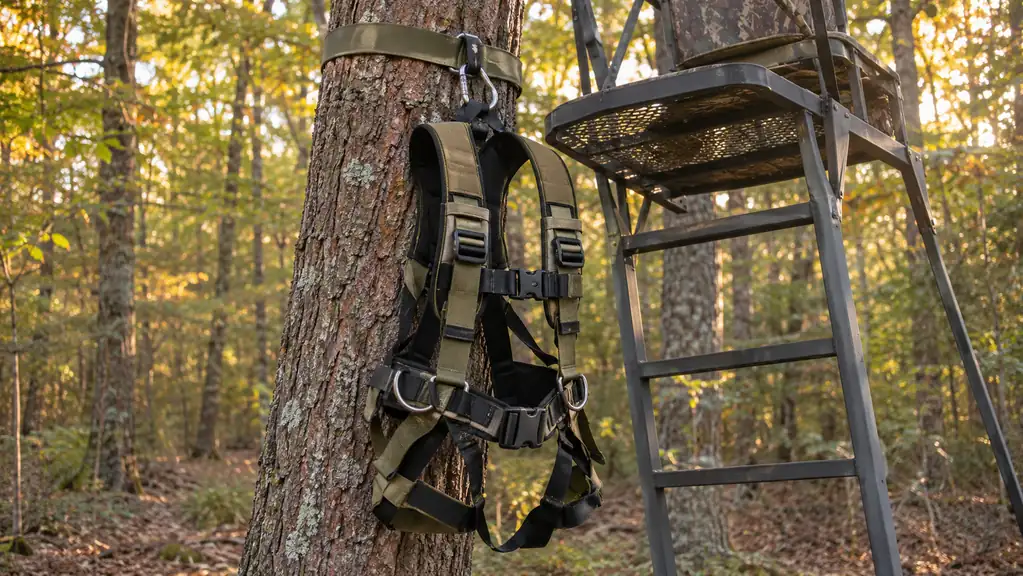
Fourth, the MOLLE attachment system. Summit Treestands calls it military-inspired, and that is exactly right. It is a grid of webbing on the front of the harness that lets you attach pouches and gear the way soldiers do. It is a genuinely useful system, but it is also a system that assumes you already own MOLLE-compatible pouches. If you do not, the grid just sits there looking tactical and doing nothing. I attached a small pouch I already owned, and it worked fine. But do not buy this harness expecting it to come with pouches, because the box contains the harness itself and nothing else.
The first time I put it on, I stood in my living room for five minutes trying to figure out which strap went where. By the third time, it was muscle memory. Practice before you need it.
What It Does Right
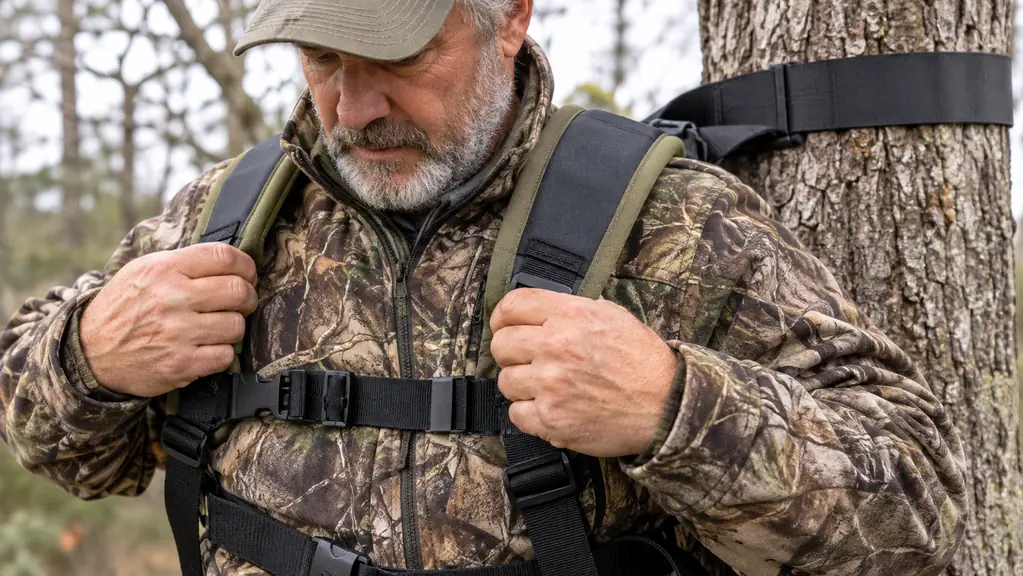
Let me be clear about the most important thing: this harness does what a safety harness is supposed to do, and it does it better than anything I have used. The torso strap holds you snug against the tree, and the padded shoulder straps spread the load across your shoulders instead of concentrating it on your waist. I have sat in it for four hours and never once felt like I was being cut in half. My old waist belt pinched and slipped. This one stayed put.
The attachment point is positioned so that when you are tied off and you lean back, the harness catches you across your chest and shoulders, not across your gut. That is the difference between a harness designed by people who understand falls and a strap that just keeps you from sliding off the platform. I have been tied off at the top of a 40-foot pole more times than I can count, and I can tell you the geometry of the attachment point matters more than any other single detail. Summit Treestands got it right. I tested it one afternoon in a way that probably sounds foolish: I sat down hard in the stand, letting my full weight come onto the strap, just to feel where it caught me. It caught me high, across the chest, the way a fall-arrest harness is supposed to. A waist belt cannot do that. It catches you low and lets you fold. That one test told me more than any spec sheet could.
The build quality is also worth mentioning. I have owned gear that fell apart after one season, and this is not that. The stitching is tight, the buckles are solid, and after a full season of being packed in and out of the truck, stepped on, rained on, and hung on a tree hook, it shows almost no wear. The care instructions say hand wash only with a mild soap solution and air dry, and I have followed that, which probably helps. But the materials feel like they were chosen for a working life, not for a catalog photo.
What I Liked
- Secure, comfortable fit that spreads the load across your shoulders and chest instead of your waist
- Torso strap and padded shoulder straps hold up through long sits
- MOLLE attachment system works with pouches you already own
- Solid build quality with tight stitching and sturdy buckles after a full season
- Honest sizing and a 300-pound weight capacity that covers most hunters
Where It Falls Short
- 5.1 pounds is heavy on the walk to the stand
- Runs warm in spring weather and would be rough in September
- Steep learning curve the first few times you put it on
- MOLLE grid is useless unless you already own compatible pouches
The Weight Question
I want to spend a little more time on the weight, because it is the thing that will make or break this harness for a lot of hunters. The specs say 5.1 pounds, and that is heavier than a lot of competitors. I am 58 years old, and I notice it on the walk in. But here is the thing I learned as a lineman: the weight of a safety device is not the question. The question is whether you will actually wear it. A two-pound harness that stays in the truck is worthless. A five-pound harness that you wear every climb is worth its weight in gold. I thought about this a lot during the season, especially on the mornings when the stand felt a long way off. Every time, I put the harness on anyway, because I knew the alternative was a strap that might as well stay in the truck.
And the weight has a side effect that surprised me: it makes the harness feel substantial. When I am sitting in the stand and I feel that weight on my shoulders, it reminds me it is there. It is not a feather that I might forget to clip in. It is a piece of equipment that I know is doing a job. For a man who spent 30 years trusting equipment with his life, that feeling matters.
Who This Is For
This harness is for the hunter who climbs into a treestand and wants to climb down the same way he climbed up. It is for the hunter who has had a close call, or who has a wife at home who has told him once too often to be careful. It is for the hunter who is willing to spend a few evenings in the living room practicing with it so that putting it on in the dark is not a puzzle. If that is you, the Summit Pro Safety Harness from Summit Treestands is the best full-body harness I have used in 46 years of hunting.
Who Should Skip It
If you hunt from a ground blind exclusively, or if you only climb into a stand a handful of times a year and you are not willing to practice with a harness at home, this is probably more harness than you need. The weight and the warmth are real, and if you are not going to wear it every time, you are better off with something lighter that you will actually use. Also, if you are between sizes, or if you are a smaller hunter who falls between the medium and large sizing, try it on before you buy, because the fit is honest and the sizes do not stretch much.
After a full season, this is the harness I trust
The Summit Pro Safety Harness is the one piece of gear that earns its spot in my truck every single hunt. Check today's price on Amazon and see if it fits your setup.
Amazon Check Today's Price on Amazon →The Bottom Line
Here is the honest bottom line from a retired lineman who has trusted equipment with his life for 30 years. The Summit Pro Safety Harness is not the lightest harness you can buy, and it is not the coolest. It runs warm in the spring, it weighs 5.1 pounds, and it takes practice to put on. But it is the most secure, most comfortable full-body harness I have used, and after a full season of hard use, it has not let me down once. Summit Treestands built this harness for a working life, and it shows.
I took a good buck and a doe last season, and I climbed down from that stand after every single sit the same way I climbed up: on my own two feet, with the harness tied off the whole time. That is the only result that matters. If you are still hunting with an old waist belt like the one I trusted for too long, do yourself a favor and look at the Summit Pro Safety Harness. Your family will thank you, and so will your knees.